
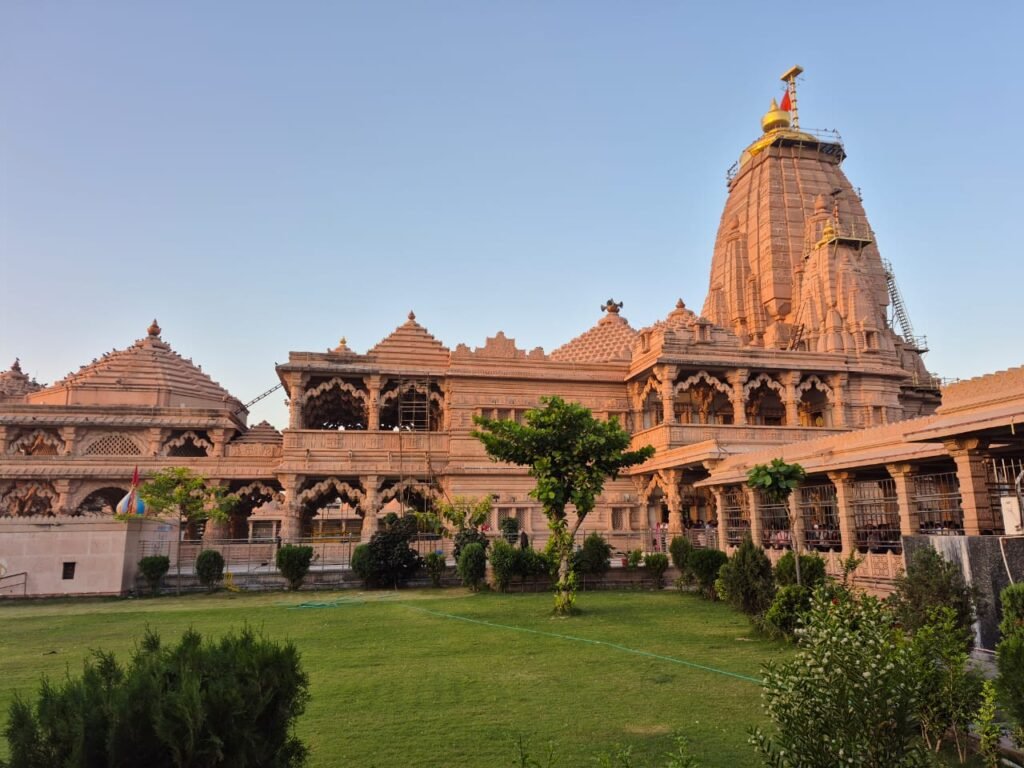
Shri Sanwaliya Seth Temple is a major Krishna pilgrimage site in Mandfiya village, Chittorgarh district, Rajasthan. The shrine is often described simply as “Sanwaliya Seth Temple, Chittorgarh”, but Mandfiya is the village where the main temple actually stands. The village is also written as Mandphiya or Mandafiya in English.
The temple’s history is closely connected with two other places: Bhadsoda, home to the oldest of the three associated shrines, and Bagund–Bhadsoda, the traditional discovery site known as Prakatya Sthal. Together, these places explain why the Sanwaliya Seth tradition has three temples rather than one.
The story begins with a reported discovery of three images of Lord Krishna in 1840. That year is consistently mentioned in local temple histories and Rajasthan Tourism’s account, but the exact circumstances of the discovery belong to religious tradition rather than independently documented archaeology. This article separates such traditions from verifiable institutional dates and official records.
Sanwaliya Seth Temple at a glance
- Main temple: Shri Sanwaliya Seth Mandir, Mandfiya (Mandphiya)
- Village and district: Mandfiya, Chittorgarh, Rajasthan
- Deity: Lord Krishna, worshipped as Sanwaliya Seth
- Traditional discovery year: 1840 CE
- Connected shrines: Mandfiya, Bhadsoda and Bagund–Bhadsoda (Prakatya Sthal)
- Major festival: Jaljhulni Ekadashi (Devjhulni Ekadashi)
- Key legal record: Shri Sanwaliaji Temple Act, 1992
1. Where Is Sanwaliya Seth Temple Located?
The main temple is on the Chittorgarh–Udaipur road corridor, roughly 40 kilometres from Chittorgarh city. Rajasthan Tourism identifies it as the grand Sanwaliya Ji Dham temple at Mandfiya, while the Ministry of Tourism also lists the village as Mandafiya.
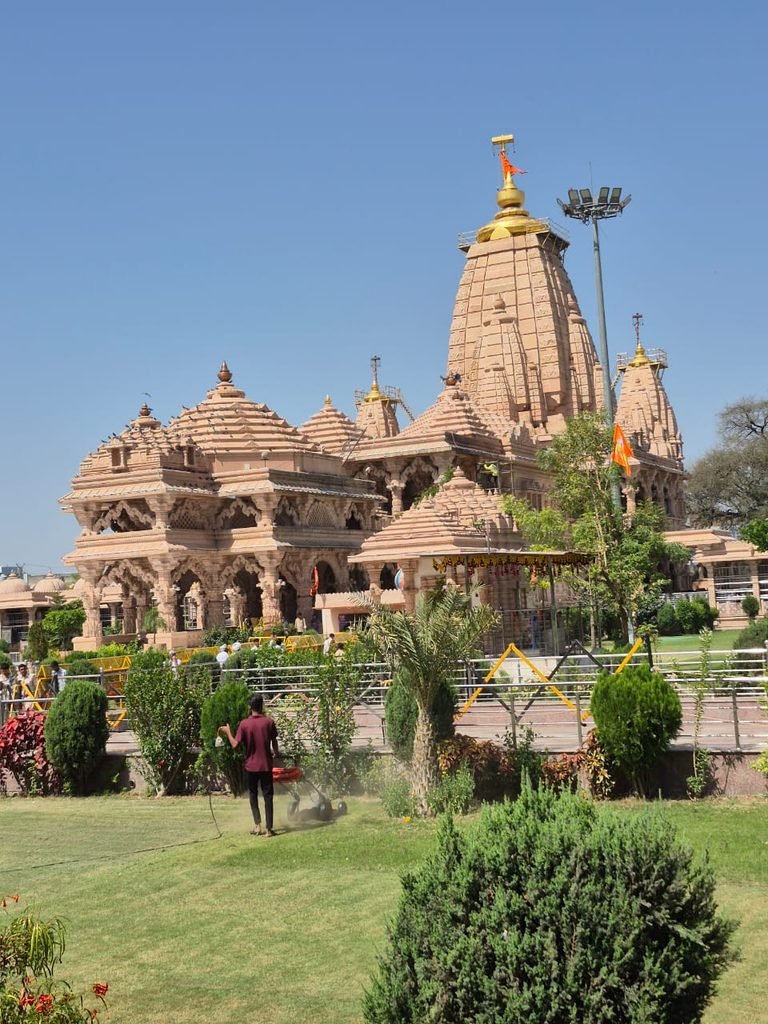
Google Maps-listed address for the main temple:
- Listing name: Shree Sanwaliya Seth Mandir, Mandfiya Rajasthan
- Address: Mandphiya, Mandfiya, Rajasthan 312027, India
- Administrative district: Chittorgarh, Rajasthan
- Open the main Mandfiya temple on Google Maps
Mandfiya and Chittorgarh are not competing locations: Mandfiya is the village; Chittorgarh is the district. The temple is outside Chittorgarh city itself. The spelling Mandphiya is also used in Rajasthan’s 1992 temple legislation.
2. The 1840 Discovery: What the Sources Actually Say
The shared origin story of the three shrines is associated with 1840 CE. Two widely available accounts explain the reported discovery differently.
The account recorded by Rajasthan Tourism
According to Rajasthan Tourism, local residents tell of a shepherd named Bholanath Gurjar who dreamed about buried images. Excavation near the boundary of Bhadsoda and Bagund reportedly uncovered three images of Krishna.
The account recorded by Prakatya Sthal temple
The Prakatya Sthal temple’s history links the discovery to roadwork between Udaipur and Chittorgarh during the Mewar state period. It says that, while removing a babul tree obstructing road construction near Bagund, workers uncovered three Krishna images.
These versions agree on the reported year, the general area and the number of images, but not on every detail of how they were found.
For a factual reading of the history:
- Documented in published institutional accounts: The three temples preserve a tradition of discovery dating to 1840.
- Part of local religious tradition: The dream, the precise excavation circumstances and explanations for the images being underground.
- Not established by the sources examined: The original carving date of the three images or a contemporary archaeological excavation report proving the discovery narrative.
It is therefore better to say “traditionally discovered in 1840” than “scientifically dated to 1840”.
3. The Three Sanwaliya Seth Temples: Addresses and Google Maps
The three shrines are related through the reported discovery, but they are separate temples with different histories.
A. Main temple: Shri Sanwaliya Seth Mandir, Mandfiya
- Role: Principal and best-known pilgrimage shrine.
- Location: Mandphiya, Mandfiya, Rajasthan 312027.
- Historical connection: Associated with the third Krishna image in the temple tradition.
- Google Maps: Mandfiya main temple
B. Oldest shrine: Shri Sanwaliya Seth Prachin Mandir, Bhadsoda
- Role: Identified by Rajasthan Tourism and its temple organisation as the oldest of the three.
- Google Maps listing: Shri Sanwariya Seth Temple, Bhadsora.
- Location: P978+M5X, Bhadsora, Rajasthan 312024 (Google Maps Plus Code and locality).
- Historical connection: Traditionally associated with the largest of the three images.
- Google Maps: Bhadsoda ancient temple
C. Discovery-site shrine: Shri Sanwaliyaji Prakatya Sthal Mandir, Bagund–Bhadsoda
- Role: Temple at the traditionally reported discovery location.
- Google Maps listing: Shri Sanwaliyaji Seth Prakatya Mandir Baagund-Bhadsoda.
- Address: N.H. 76, Chouraha, Bagund, Bhadsora, Rajasthan 312024, India.
- Historical connection: Preserves the location associated with the emergence of the three images.
- Google Maps: Prakatya Sthal temple
Spelling note: Bhadsoda is also written Bhadsora or Bhadsauda. Map addresses and listing titles may be updated by Google.
4. Bhadsoda: The Oldest Sanwaliya Seth Temple
According to the Bhadsoda Prachin Mandir’s published history, a religious figure named Puraji Bhagat, from the Suthar community, helped arrange the care of the three discovered images.
That account describes the following sequence:
- The largest image was taken to Bhadsoda.
- A shrine was constructed there under Puraji Bhagat’s guidance.
- The local Bhinder estate was involved in supporting its establishment.
- Since this temple was established first among the three, it became known as Prachin Mandir, or the ancient temple.
Rajasthan Tourism likewise identifies Bhadsoda as the oldest shrine in this group. That does not mean every part of today’s building has been independently dated to 1840. The exact construction date of the first structure is not firmly established by the cited records.
5. Bagund–Bhadsoda: Why the Prakatya Sthal Matters
Prakatya Sthal means a place of appearance or manifestation. It is the name given to the traditional discovery location near Bagund and Bhadsoda.
The Prakatya Sthal organisation records that the site originally had a modest shrine before its twentieth-century expansion. Its importance is therefore twofold:
- Religious history: It is the place where the three Krishna images are traditionally said to have been found.
- Community history: It documents how local support helped transform a small worship site into a larger complex from 1961 onward.
Prakatya Sthal is sometimes mistaken for the Mandfiya temple in online articles. They are different locations, and construction milestones at one should not be assigned to the other.
6. How Mandfiya Became the Main Pilgrimage Centre
The third image from the reported 1840 discovery was, according to the temple histories, taken to Mandfiya. Worship developed around it, and the shrine became increasingly well known.
Today the Mandfiya temple is the principal destination associated with Sanwaliya Seth. Its significance can be seen in:
- A large temple complex accommodating religious gatherings and visiting devotees.
- An established programme of daily worship and major festivals.
- State legislation specifically governing the temple and its endowments.
- Contemporary reporting on substantial offerings and the management of temple funds.
The exact dates of every early building phase at Mandfiya are not established in the primary sources used here. The shrine’s traditional founding story should not be confused with the age of the entire present-day structure.
7. Sanwaliya Seth in the Religious Landscape of Mewar
Mandfiya, Bhadsoda and Bagund all lie in Mewar, a historic region of southern Rajasthan. The area has long-standing traditions of Hindu worship, including devotion to Vishnu and Krishna.
The development of Sanwaliya Seth worship illustrates several features of regional temple history:
- Local religious leadership: Puraji Bhagat appears in the Bhadsoda temple’s early account.
- Regional patronage: The Bhadsoda account mentions support from the Bhinder estate.
- Community participation: Villagers and supporters helped expand Prakatya Sthal in the twentieth century.
- Formal institutions: Mandfiya later acquired a statutory board through Rajasthan legislation.
For more evidence-based articles on the history, temples and traditions of Hinduism, explore RishiSaar.
8. Prakatya Sthal’s Recorded Expansion: 1961 to 2011
The clearest published construction timeline belongs to the Prakatya Sthal temple, not the main Mandfiya shrine.
According to its official historical account:
- 1961: Organised construction, expansion and beautification work began. Motilal Mehta of Bhadsoda is credited with a leading role.
- From 1961: The site also began hosting a large annual Devjhulni/Jaljhulni Ekadashi fair, according to the temple organisation.
- 1978: A flag-hoisting ceremony took place in the presence of a large gathering.
- February 2011: A gold-plated finial was installed on a 36-foot-high shikhara, followed by a flag ceremony.
The temple’s account also credits local supporters with contributing materials, labour and organisational help. These details are valuable because they show a recorded period of community-led development.
Important: The 36-foot shikhara and 2011 finial date are Prakatya Sthal facts. They should not be used as the construction timeline for Mandfiya.
9. The 1986 Trust and the Shri Sanwaliaji Temple Act, 1992
One of the most reliable documentary sources for Mandfiya’s modern history is the Shri Sanwaliaji Temple Act, 1992, published through the Government of India’s India Code portal.
Key dates and provisions:
- 19 June 1986: The Act refers to the registration of the Shri Sanwaliaji Trust under the Rajasthan Public Trusts Act, 1959.
- 2 December 1991: The 1992 Act was deemed to have come into force from this date.
- 26 March 1992: The Act received presidential assent.
- Temple Board: The law provides for a statutory Shri Sanwaliaji Temple Board to manage the Mandfiya shrine and its endowments.
- Deity’s ownership: The Act places ownership of the temple and its endowments in the deity, while assigning administration to the Board.
- Accounts and expenditure: It lays out provisions relating to management, funds, records and permitted uses of temple resources.
This legislation concerns the temple at Mandphia/Mandfiya. It should not be assumed to govern every associated shrine under the same arrangements.
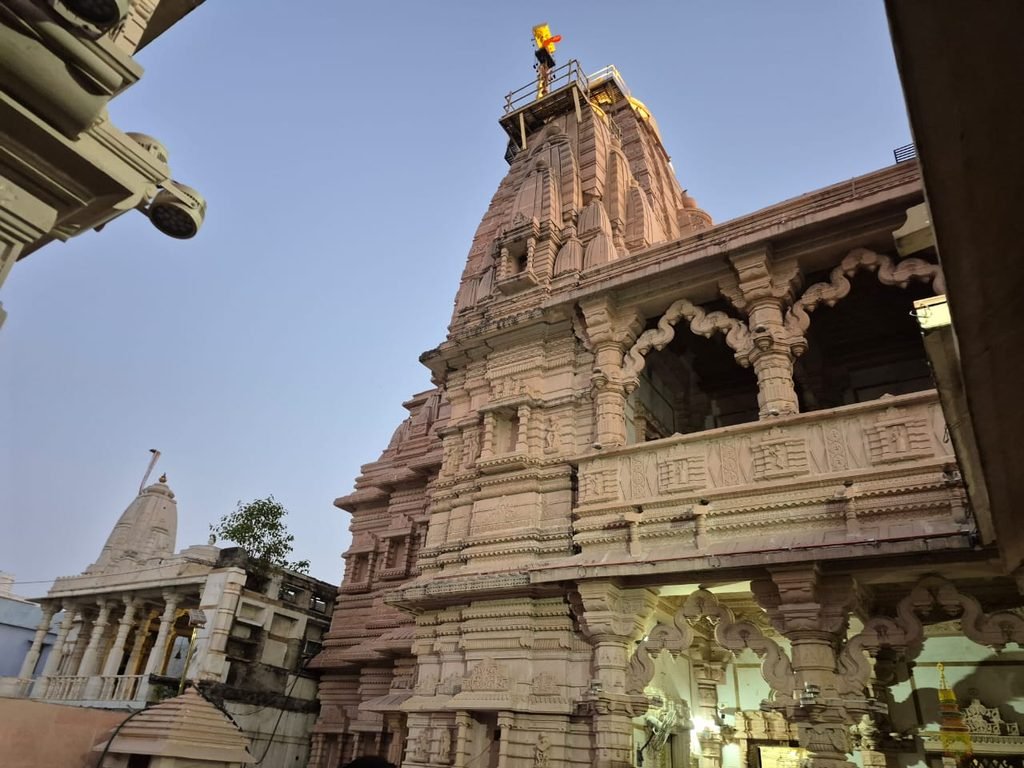
10. Architecture of the Main Temple at Mandfiya
The Mandfiya complex is recognised for its prominent temple tower, ornamental stonework and spaces for worshippers. Its present appearance reflects the growth of an important contemporary pilgrimage centre.
Features visitors can observe include:
- A shikhara, the tower rising above the main shrine.
- Carved architectural details and decorative surfaces.
- The central worship area dedicated to Krishna as Sanwaliya Seth.
- Circulation areas and facilities intended for large numbers of pilgrims.
Architecture needs careful dating. A traditional nineteenth-century origin does not prove that the whole structure visible today was built in 1840. The cited sources do not offer a complete construction history for every part of the Mandfiya complex.
11. Sanwaliya Seth and Merchant Devotion
Sanwaliya Seth is particularly well known for a form of devotion practised by some traders and business owners. Contemporary reports describe devotees who voluntarily offer a share of business earnings to the temple.
What can be stated without exaggeration:
- Such offerings are acts of personal religious devotion, not legally enforceable business partnerships.
- The amount or percentage given is decided by individual devotees; there is no universal fixed percentage.
- Both small personal donations and large offerings form part of the modern public history of the shrine.
A July 2026 NDTV report describes this symbolic “business partner” relationship and the temple’s donation-handling procedures.
12. Donations and Financial Administration
Donations to the Mandfiya shrine have attracted national news coverage. They include cash offerings as well as gold, silver and other valuables.
For a dated, checkable example, Moneycontrol reported on 26 April 2026 that ₹41.67 crore had been recorded over 29 days, from 18 March to 16 April 2026, based on the temple authorities’ figures. This is a period-specific reported collection, not a constant monthly amount.
The modern temple’s financial story involves more than the size of donations:
- Collections: Offerings are periodically counted and recorded.
- Administration: The Temple Board operates under the 1992 Act.
- Accountability: The law contains provisions covering temple finances and records.
- Facilities: The Act identifies authorised purposes for expenditure, including worship, upkeep and specified pilgrim or charitable facilities.
A legal power to spend on a particular purpose does not establish that every such project has been completed; individual projects require their own evidence.
13. Different Names of Sanwaliya Seth Temple and Their Meanings
The same Krishna shrine is frequently searched for under several English spellings. The variations result mainly from transliteration of Hindi and regional usage; they do not mean that all similarly named temples are the same physical location.
Common names and spelling variations:
- Sanwaliya Seth Temple / Sanwaliya Seth Mandir — common English usage.
- Sanwariya Seth Temple / Sanwariya Seth Mandir — very widely used spelling variation.
- Sawariya Seth Mandir — another common English search form.
- Shri Sanwaliya Seth Ji Mandir — devotional form with honorifics.
- Sanwaliya Ji / Sanwaliyaji Temple — shortened respectful form.
- Sanwaliaji Temple — spelling used in the Shri Sanwaliaji Temple Act, 1992.
- Shri Sanwaliya Ji Dham — name used for the main pilgrimage shrine at Mandfiya.
What does the name mean?
- Sanwaliya / Sanwariya: A devotional reference to Krishna’s dark or dusky complexion.
- Seth: A word used for a prosperous merchant or businessman, reflected in the temple’s association with merchant devotees.
- Ji / Shri: Respectful forms of address often included in religious names.
Names of the village can vary too: Mandfiya, Mandphiya, Mandafiya, Mandaphia and Mandaphiya are spellings encountered for the main temple’s locality. Google Maps shows Mandphiya, Mandfiya, while the 1992 Act uses Mandphia.
For accurate directions, search for “Shree Sanwaliya Seth Mandir, Mandfiya Rajasthan” rather than using the deity’s name alone, because other temples share similar names.
14. Jaljhulni Ekadashi: The Major Sanwaliya Seth Festival
Jaljhulni Ekadashi, also called Devjhulni Ekadashi, is among the most important celebrations associated with the temples. The festival occurs during the bright fortnight of the Hindu month of Bhadrapada.
Government tourism information describes a three-day fair at Mandfiya, typically involving:
- Dashami: A procession and religious or cultural programmes.
- Ekadashi: A rath yatra (chariot procession) and a ceremonial bathing observance near a water site.
- Dwadashi: Concluding cultural and religious events.
The Government of India’s festival listing recorded celebrations at Mandfiya on 21–23 September 2026. Festival dates change each year with the Hindu calendar.
At Prakatya Sthal, the temple organisation separately records a major fair tradition beginning in 1961, including processions from the neighbouring communities. The programmes at the two sites should not be merged into a single temple schedule.
15. Darshan, Aarti and Visitor Information
The Mandfiya temple follows a daily programme of worship. Rajasthan Tourism publishes named ritual slots including Mangala Aarti, Rajbhog, afternoon Aarti, evening Aarti and bhajan.
According to the Ministry of Tourism’s listing, general visiting periods are:
- Morning: Approximately 5:30 AM–12:00 noon.
- Afternoon and evening: Approximately 2:30 PM–11:00 PM.
- Midday: A break separates the two general visiting sessions.
These are published visitor timings, not guaranteed live opening hours. Festival arrangements and temple notices can change access. Bhadsoda and Prakatya Sthal are separate temples and may follow different schedules.
16. Sanwaliya Seth Temple Historical Timeline
| Year | What happened | How it is supported |
|---|---|---|
| 1840 | Reported discovery of three Krishna images near Bagund–Bhadsoda | Temple histories and Rajasthan Tourism; traditional account |
| After 1840 | Separate shrines became associated with Bhadsoda, Prakatya Sthal and Mandfiya | Temple histories; precise original building dates unconfirmed |
| 1961 | Organised expansion and an annual fair began at Prakatya Sthal | Prakatya Sthal temple account |
| 1978 | Flag-hoisting ceremony at Prakatya Sthal | Prakatya Sthal temple account |
| 19 June 1986 | Registration of Shri Sanwaliaji Trust | Referenced in the 1992 Act |
| 2 December 1991 | Date from which the temple Act was deemed effective | Official legislation |
| 26 March 1992 | Presidential assent to the Shri Sanwaliaji Temple Act, 1992 | Official legislation |
| February 2011 | Finial installation on Prakatya Sthal’s 36-foot shikhara | Prakatya Sthal temple account |
| April 2026 | News reporting documents ₹41.67 crore collected over a 29-day period | Moneycontrol, citing temple authorities |
Reading the timeline correctly: A traditional date is not the same as a date independently established through legislation, a dated organisational record or contemporary reporting.
17. Historical Facts Versus Local Traditions
Several popular claims about Sanwaliya Seth are important to the devotional tradition but require careful wording in a factual article.
- The dream of Bholanath Gurjar: Recorded by Rajasthan Tourism as a story told by local residents; not independently documented as a historical occurrence.
- Burial to protect the idols from attackers: Found in some temple traditions; the exact reason for burial has not been independently established here.
- The age of the idols: The reported discovery in 1840 does not establish their carving date.
- A direct connection with Mirabai: The Bhadsoda temple’s account discusses this as a devotional association. Available evidence cited here does not independently establish that Mirabai worshipped these particular surviving images.
- The age of the present Mandfiya building: No complete, independently verified construction chronology has been established for every part of the complex.
A good history article can include these traditions with clear attribution while keeping confirmed dates and observable facts separate.
18. How to Reach the Three Temples
The main temple at Mandfiya is accessible from Chittorgarh and Udaipur by road. Visitors with an interest in the region’s temple history may also travel to the nearby Bhadsoda and Prakatya Sthal shrines.
Useful travel details:
- By road: Mandfiya is on the Chittorgarh–Udaipur corridor, approximately 40 km from Chittorgarh city.
- By train: Chittorgarh is a major nearby railway connection.
- By air: Maharana Pratap Airport near Udaipur serves the wider region.
- Before visiting: Check current darshan hours, festival crowd arrangements and directions for each temple separately.
Save the three map links: Mandfiya main shrine · Bhadsoda Prachin Mandir · Bagund–Bhadsoda Prakatya Sthal.
19. Frequently Asked Questions
Is Sanwaliya Seth Temple in Mandfiya or Chittorgarh?
Both names are relevant: Mandfiya is the village where the main temple stands, and Chittorgarh is its district in Rajasthan. The temple is not in central Chittorgarh city.
Which is the oldest of the three Sanwaliya Seth temples?
The shrine at Bhadsoda, called Shri Sanwaliya Seth Prachin Mandir, is identified by Rajasthan Tourism and its temple organisation as the oldest of the three.
What happened in 1840?
According to the local temple histories, three Krishna images were discovered near Bagund–Bhadsoda. The date is part of the established temple tradition, while the detailed discovery narratives have not been independently verified through archaeological records.
What is the exact Google Maps address of the main temple?
The Google Maps listing gives Mandphiya, Mandfiya, Rajasthan 312027, India. Open the Mandfiya temple on Google Maps.
Are Sanwaliya Seth and Sanwariya Seth different deities?
No. These are spelling and pronunciation variations used for Krishna as Sanwaliya Seth. However, different temples may be dedicated to the same deity, so a location is still needed when searching for a specific shrine.
Who manages Sanwaliya Seth Temple in Mandfiya?
The Mandfiya shrine is governed under the Shri Sanwaliaji Temple Act, 1992, which provides for a statutory Temple Board.
What is the main festival of Sanwaliya Seth Temple?
Jaljhulni Ekadashi is a major annual festival at Mandfiya, with processions and religious events that are traditionally held over three days.
Conclusion
The history of Shri Sanwaliya Seth Temple in Mandfiya, Chittorgarh is best understood through the three connected Krishna shrines. Local tradition traces the discovery of three images to 1840; the Bhadsoda temple is identified as the oldest shrine, Prakatya Sthal at Bagund–Bhadsoda marks the reported discovery location, and Mandfiya became the principal pilgrimage destination.
The temple tradition also has a documented modern history: community-led expansion at Prakatya Sthal from 1961, the Mandfiya trust registration mentioned for 1986, and statutory management under the 1992 Act. Separating these records from the traditional origin narratives makes the history more precise without overlooking the cultural importance of the stories.
For more researched explainers on Hindu temples, traditions and historical facts, visit RishiSaar.
Sources and Further Reading
- Rajasthan Tourism — Chittorgarh and Sanwaliya Ji Temple — Main Mandfiya location, three temples and the local discovery tradition.
- Ministry of Tourism — Sanwaliya Ji Temple — Location, history summary and published darshan timings.
- Shri Sanwaliya Seth Prachin Mandir, Bhadsoda — History — The oldest shrine’s history and the three-image tradition.
- Shri Sanwaliyaji Prakatya Sthal Mandir — History — Discovery tradition, 1961 expansion, 1978 ceremony and 2011 finial.
- Shri Sanwaliyaji Prakatya Sthal Mandir — Administration — Participation of five nearby villages.
- India Code — Shri Sanwaliaji Temple Act, 1992 (PDF) (searchable text) — Statutory administration of the Mandfiya shrine.
- Incredible India — Jaljhulni Ekadashi, Chittorgarh — Official festival programme and description.
- Moneycontrol, 26 April 2026 — Reported Temple Donations — Dated donation figures attributed to temple authorities.
- NDTV, 17 July 2026 — Temple Donations and Merchant Devotion — Contemporary coverage of donation processes and business-related offerings.
Editorial note: The 1840 origin narratives are identified as local temple traditions. Legal dates are sourced to the Act, and later construction dates are attributed to the organisation of the specific temple concerned. Google Maps listing names and addresses were checked in October 2026 and can change.