
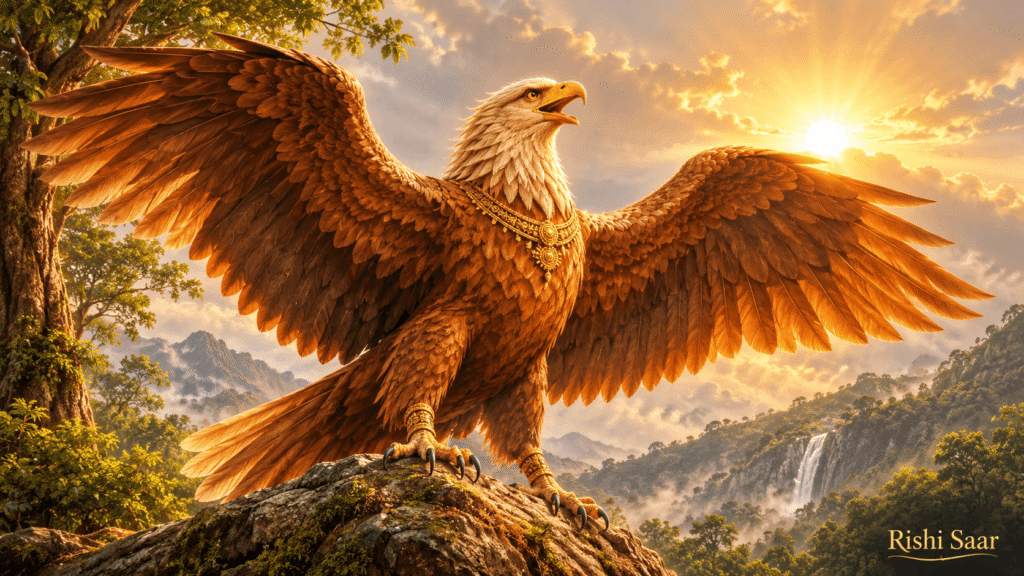
Not every hero in the Ramayana carried a divine weapon, commanded an army or emerged victorious from battle. Some became immortal through the choices they made when confronted with adharma. Jatayu, the mighty king of vultures, was one such hero.
At an advanced age of 60,000 years, Jatayu confronted Ravana as he was abducting Mata Sita. Despite knowing the limitations of his ageing body, he refused to remain a silent witness to injustice. His extraordinary strength, wisdom, loyalty and selfless sacrifice earned him a place among the most revered devotees of Shri Rama.
However, there is much more to Jatayu’s story than his battle with Ravana. His divine ancestry connects him to Garuda, his childhood adventure reveals his extraordinary abilities, and his final moments contain profound teachings on dharma, devotion and liberation.
Who Was Jatayu in the Ramayana?
Jatayu (जटायु) was a mighty celestial bird, the king of vultures, a close friend of King Dasharatha and a devoted well-wisher of Shri Rama. In the Valmiki Ramayana, he is described as a Gridhra Raja, meaning the king of vultures.
Although Jatayu is frequently depicted as an eagle in popular illustrations and adaptations, the Sanskrit word Gridhra generally refers to a vulture.
Unlike an ordinary bird, Jatayu possessed extraordinary physical strength, the ability to communicate with humans, knowledge of dharma and remarkable aerial capabilities. His royal lineage and understanding of righteous conduct made him much more than a warrior.
Jatayu’s character demonstrates that nobility in Hindu scriptures is determined not merely by one’s birth or physical form but also by one’s actions and adherence to dharma.
Scriptural reference: Valmiki Ramayana, Aranya Kanda, Sargas 14 and 50.
The Divine Ancestry of Jatayu: Was He Related to Garuda?
Jatayu belonged to one of the most remarkable avian lineages described in Hindu scriptures. His father was Aruna, the celestial charioteer of Surya Deva, and his mother was Shyeni, according to the Valmiki Ramayana.
Aruna and Garuda were brothers, born to Sage Kashyapa and Vinata. Garuda, therefore, was Jatayu’s paternal uncle.
Jatayu’s family lineage can be understood as follows:
- Grandfather: Sage Kashyapa
- Grandmother: Vinata
- Father: Aruna, the charioteer of Surya Deva
- Mother: Shyeni
- Paternal uncle: Garuda, the divine vehicle of Bhagavan Vishnu
- Elder brother: Sampati
This genealogy is also supported by the Mahabharata’s Adi Parva, Section 66.
Interestingly, the Brahmanda Purana identifies Gṛdhri as the mother of Sampati and Jatayu and describes both brothers as exceptionally powerful birds. This represents a variation in the genealogical traditions preserved by different scriptures.
Although Jatayu belonged to Garuda’s family, the two were distinct personalities. Jatayu is not identified as an incarnation of Garuda in the Valmiki Ramayana.
Scriptural references: Valmiki Ramayana, Aranya Kanda 14.31–33; Mahabharata, Adi Parva, Section 66; Brahmanda Purana, Section 3, Chapter 7, Verses 447–448.
When Jatayu and Sampati Flew Towards the Sun
Long before Jatayu encountered Ravana, he and his elder brother Sampati undertook an extraordinary challenge that changed their lives.
During their youth, the brothers decided to test their strength and flying abilities by soaring towards the Sun. As they ascended higher, the intense solar heat began to overwhelm Jatayu.
Realising that his younger brother was in danger, Sampati spread his enormous wings above Jatayu to shield him from the scorching rays. In protecting his brother, Sampati’s own wings were burnt, causing him to fall upon the Vindhya mountains.
This incident separated the two brothers.
The story becomes particularly meaningful when viewed alongside Jatayu’s later sacrifice. In his youth, Jatayu was saved by a brother who risked his own well-being. In his old age, Jatayu displayed a similar spirit of selflessness while attempting to protect Mata Sita.
A lesser-known version in the Brahma Purana
The Gautami Mahatmya of the Brahma Purana preserves a different account of this incident. According to Chapter 96, both Jatayu and Sampati suffered injuries to their wings after approaching the Sun.
Upon Aruna’s appeal, Surya Deva revived them. The narrative also associates Garuda, Bhagavan Vishnu and the sacred banks of the Gautami River with their recovery.
This episode is connected with a sacred pilgrimage site known as Patatri Tirtha.
The two accounts differ in their details, but both preserve the tradition of Jatayu and Sampati possessing extraordinary celestial flying abilities.
Scriptural references: Valmiki Ramayana, Kishkindha Kanda 58.4–8 and Sarga 61; Brahma Purana, Gautami Mahatmya 96.2–13.
How Did Jatayu Become the Protector of Mata Sita?
During their fourteen-year exile, Shri Rama, Mata Sita and Lakshmana encountered Jatayu while travelling towards Panchavati.
Upon seeing his enormous form, Rama and Lakshmana initially wondered whether he was a Rakshasa. Jatayu introduced himself as an old friend of their father, King Dasharatha, and narrated his ancestry.
After learning about his connection with Dasharatha, Shri Rama warmly embraced him.
Jatayu then voluntarily offered to assist the royal family during their stay in the forest. He assured Rama that he would watch over Mata Sita whenever the two brothers ventured away from their dwelling.
This promise would eventually become the defining commitment of his life.
Jatayu was under no royal command to protect Sita. His responsibility arose from affection, loyalty and his understanding of dharma.
Scriptural reference: Valmiki Ramayana, Aranya Kanda 14.1–5 and 14.33–36.
How Old Was Jatayu When He Fought Ravana?
According to the Valmiki Ramayana, Jatayu was 60,000 years old when he confronted Ravana.
Jatayu himself reveals his age in Aranya Kanda, Verse 3.50.20:
षष्टि वर्ष सहस्राणि जातस्य मम रावण ।
पितृ पैतामहम् राज्यम् यथावत् अनुतिष्ठतः ॥
Meaning: O Ravana, sixty thousand years have passed since my birth, during which I have upheld the kingdom inherited from my ancestors.
In the following verse, Jatayu acknowledges that Ravana is younger, armed and equipped for battle, whereas he himself has grown old.
Nevertheless, he refuses to allow Ravana to carry Sita away unchallenged.
The stated age belongs to the epic’s traditional narrative and should not be confused with the biological lifespan of ordinary vultures.
Scriptural reference: Valmiki Ramayana, Aranya Kanda 50.20–21.
Jatayu and Ravana: The Battle Between Dharma and Adharma
When Ravana abducted Mata Sita from Panchavati, her cries reached Jatayu, who was resting upon a tree.
An often-overlooked detail in the Valmiki Ramayana is that Sita did not initially ask Jatayu to fight Ravana. Recognising the danger posed by the powerful Rakshasa king, she requested that Jatayu inform Rama and Lakshmana about her abduction.
However, Jatayu decided to intervene.
Jatayu’s teachings on Raja Dharma
Before engaging Ravana in battle, Jatayu attempted to reason with him.
He reminded Ravana that a king must protect others rather than misuse his authority to harm them. He explained that a ruler’s behaviour influences the moral conduct of his subjects and that abducting another person’s wife violated righteous conduct.
In essence, Jatayu challenged Ravana not merely as an enemy of Shri Rama but as a king who had abandoned his own responsibilities.
This conversation reveals an important dimension of Jatayu’s personality. He possessed a deep understanding of Raja Dharma — the ethical duties of a ruler — and sought to prevent wrongdoing through counsel before resorting to confrontation.
Ravana, however, refused to release Sita.
Scriptural references: Valmiki Ramayana, Aranya Kanda 49.36–40 and Sarga 50.
The extraordinary battle between Jatayu and Ravana
The battle that followed was so remarkable that Maharishi Valmiki compared the two opponents to colossal winged mountains clashing against one another.
Despite his advanced age, Jatayu destroyed Ravana’s bows and chariot, inflicted considerable damage upon him and temporarily brought the mighty ruler of Lanka to the ground.
The beings witnessing the confrontation praised Jatayu’s bravery.
However, the prolonged struggle exhausted the ageing bird. Ravana eventually severed Jatayu’s wings with his sword, leaving him mortally wounded.
On seeing Jatayu fall, Mata Sita rushed towards him in sorrow, grieving for him as she would for a member of her own family.
Although Jatayu could not prevent her abduction, he had accomplished something remarkable: he had stood against one of the most formidable warriors in the Ramayana without an army or divine weapons of his own.
Scriptural reference: Valmiki Ramayana, Aranya Kanda, Sarga 51.
Was Jatayu More Powerful Than Ravana?
The Valmiki Ramayana does not establish Jatayu as being more powerful than Ravana overall. However, it clearly portrays him as an extraordinarily powerful opponent who seriously challenged Ravana despite his advanced age.
Aranya Kanda 51.21 specifically identifies age-related exhaustion as a factor that weakened Jatayu during the battle.
Furthermore, in Kishkindha Kanda 57.18, Angada describes Ravana as the stronger opponent who ultimately slew Jatayu.
Jatayu’s performance has led to the popular belief that he might have defeated Ravana had they encountered each other during Jatayu’s youth. While this possibility makes for an interesting discussion, no cited passage of the Valmiki Ramayana confirms such a hypothetical outcome.
What the scriptures establish is that Jatayu possessed immense strength, remarkable endurance and exceptional courage.
Ravana won their physical confrontation, but in the moral conflict between dharma and adharma, Jatayu emerged as the greater personality.
Scriptural references: Valmiki Ramayana, Aranya Kanda 51.20–23 and Kishkindha Kanda 57.18.
The Death of Jatayu: His Final Service to Shri Rama
After discovering that Mata Sita was missing, Rama and Lakshmana searched the forest until they encountered the severely wounded Jatayu.
Despite approaching death, Jatayu gathered enough strength to explain that Ravana had abducted Sita and travelled southwards with her.
He also identified Ravana as the son of Vishrava and the brother of Kubera.
Even during his final moments, Jatayu encouraged Rama not to lose hope. He expressed confidence that Ravana would meet his destruction and that Rama would eventually reunite with Sita.
Having conveyed the essential information, Jatayu breathed his last in the presence of Shri Rama.
His final service transformed Rama’s desperate search into one guided by the identity of the abductor and the direction in which he had travelled.
Jatayu’s sacrifice was, therefore, not merely an unsuccessful attempt to rescue Sita. It became a crucial contribution to the mission that would eventually lead to her liberation.
Scriptural references: Valmiki Ramayana, Aranya Kanda, Sargas 67–68.
Why Did Shri Rama Perform Jatayu’s Last Rites?
One of the most emotionally powerful moments in the Ramayana occurs after Jatayu’s death.
Shri Rama expressed profound grief and declared that Jatayu deserved the same honour and reverence that he offered to his father, King Dasharatha.
Rama personally performed Jatayu’s cremation with the assistance of Lakshmana. The brothers subsequently offered water oblations on the banks of the Godavari River in accordance with funeral customs.
This episode is also recorded in the Bhagavata Purana, which specifically acknowledges that Bhagavan Rama performed the funeral ceremony of Jatayu.
The significance of this act extends beyond gratitude. By fulfilling a responsibility traditionally associated with close family members, Shri Rama demonstrated that relationships formed through love, loyalty and sacrifice could transcend biological kinship.
Jatayu was not born into Rama’s family, yet he earned a place within it through his actions.
Scriptural references: Valmiki Ramayana, Aranya Kanda 68.26–37; Srimad Bhagavata Purana 9.10.12.
Did Jatayu Attain Moksha?
Yes. Jatayu’s attainment of liberation is supported by the Vaishnava scriptural tradition, particularly the Srimad Bhagavata Purana.
In the Valmiki Ramayana, Shri Rama blesses Jatayu to attain exalted spiritual realms. The epic subsequently describes him as having reached an auspicious destination.
The Bhagavata Purana offers a more explicit devotional perspective.
In Canto 11, Chapter 12, Verses 3–6, Bhagavan Krishna includes Jatayu among the personalities who attained His supreme abode through association with devotees and spiritual devotion.
Sant Tulsidas also describes Jatayu’s departure to Hari’s abode in the Ramcharitmanas. In this devotional retelling, Jatayu seeks uninterrupted devotion rather than worldly rewards.
Jatayu’s story thus illustrates that spiritual liberation is not necessarily dependent upon human birth, social position, scholarly accomplishments or physical strength.
His devotion found its fullest expression through selfless service.
Scriptural references: Valmiki Ramayana, Aranya Kanda 68.29–37; Srimad Bhagavata Purana 11.12.3–7; Ramcharitmanas, Aranya Kanda, Doha 32.
How Sampati Completed Jatayu’s Unfinished Mission
Jatayu’s contribution to the Ramayana did not end with his death.
When Hanuman, Angada and the other Vanaras were searching for Mata Sita, they encountered Sampati, Jatayu’s elder brother.
Upon hearing about Jatayu’s death, Sampati was overcome with grief. Although he lacked the physical ability to avenge his brother, he possessed knowledge that proved invaluable to the search party.
Sampati revealed that Sita was in Lanka, across the ocean. This information gave the Vanaras a definite destination and paved the way for Hanuman’s extraordinary journey.
The Agni Purana also preserves this episode, connecting Sampati’s earlier sacrifice, Jatayu’s death and the discovery of Sita’s whereabouts.
In this way, the two brothers contributed to Rama’s mission through different abilities. Jatayu offered his physical strength and ultimately his life, while Sampati offered knowledge when physical strength was no longer available to him.
Together, they demonstrate that service to dharma can take many forms.
Scriptural references: Valmiki Ramayana, Kishkindha Kanda, Sargas 56–63; Agni Purana, Chapter 8, Verses 12–16.
What Does Jatayu Symbolise in Hinduism?
Jatayu occupies a distinctive place in Hindu spiritual literature because his greatness lies not in conquest but in his response to injustice.
His story offers several timeless teachings.
Dharma is greater than personal convenience
Jatayu could have remained uninvolved, citing his age and the overwhelming strength of his opponent. Instead, he accepted the responsibility of opposing wrongdoing.
True strength includes moral courage
Ravana possessed immense physical power, but Jatayu possessed the courage to use his abilities in defence of another. His story distinguishes the possession of power from its righteous use.
Devotion is expressed through action
Jatayu demonstrated his devotion to Shri Rama by honouring his promise to protect Mata Sita. His actions became a form of bhakti.
Success is not the only measure of righteous action
Jatayu could not rescue Sita, yet his efforts were honoured by Shri Rama. His story reminds us that the value of a noble action cannot always be measured by its immediate outcome.
Compassion transcends physical identity
Shri Rama’s treatment of Jatayu demonstrates that love, dignity and spiritual worth are not limited to human beings.
Conclusion
Jatayu’s story is among the most moving expressions of courage, loyalty and devotion in the Ramayana.
Born into a celestial lineage, endowed with extraordinary strength and guided by dharma, Jatayu used the final moments of his life to protect another and serve Shri Rama.
His legacy does not rest upon defeating Ravana. It rests upon his refusal to abandon righteousness when confronted by a seemingly insurmountable adversary.
Ravana took away Jatayu’s wings, but he could not take away the spiritual greatness that Jatayu had earned through his sacrifice.
For this reason, Jatayu remains immortal in the collective memory of Hindu tradition — not simply as a mighty bird, but as a profound embodiment of selfless devotion.
Next Read: Hanuman Chalisa with English Meaning
Frequently Asked Questions About Jatayu
Did Shri Rama initially mistake Jatayu for Sita’s killer?
Yes. When Rama encountered the wounded Jatayu during his search for Sita, he initially suspected that the enormous, blood-covered demon disguised as a vulture had devoured her. Jatayu immediately clarified that Ravana had abducted Sita and mortally wounded him during their confrontation.
Reference: Valmiki Ramayana, Aranya Kanda 67.9–16.
Which sword did Ravana use to cut Jatayu’s wings?
The Valmiki Ramayana refers to Ravana’s weapon as a Khadga, meaning a sword, in Aranya Kanda 51.42. Although popular retellings often identify it as Ravana’s divine sword Chandrahasa, the verse describing Jatayu’s injury does not explicitly name the weapon.
Reference: Valmiki Ramayana, Aranya Kanda 51.42.
What was the Vinda Muhurta mentioned by Jatayu before his death?
Vinda Muhurta was the period during which, according to Jatayu, Ravana carried Sita away. Jatayu explained that something lost during this particular period would be recovered by its rightful possessor. He used this traditional belief to reassure Rama about Sita’s eventual return.
Reference: Valmiki Ramayana, Aranya Kanda 68.12–14.
Did Jatayu have any children according to the Puranas?
Yes. The Brahmanda Purana includes Jatayu in its genealogical account of celestial birds and attributes several categories of birds, including vultures, to his descendants. His offspring are not central characters in the Valmiki Ramayana’s main narrative.
Reference: Brahmanda Purana, Section 3, Chapter 7, Verses 448–454.
Where did Jatayu fall after fighting Ravana?
Several regional traditions identify places associated with Jatayu’s fall. Chadayamangalam in Kerala, home to Jatayu Earth’s Center, and Lepakshi in Andhra Pradesh are two prominent examples. However, the Valmiki Ramayana does not explicitly identify either modern location as the precise site of his fall. It does mention the Godavari River in connection with his funeral rites.
Reference: Valmiki Ramayana, Aranya Kanda 68.35–36; Kerala Tourism and Incredible India regional accounts.
Did Shri Rama perform Jatayu’s cremation but not Dasharatha’s?
Yes. Bharata conducted King Dasharatha’s cremation because Rama was serving his exile in the forest. Rama later offered water and food oblations for his departed father at the Mandakini River. In Jatayu’s case, Rama was personally present and performed the cremation himself.
References: Valmiki Ramayana, Ayodhya Kanda, Sargas 76 and 103; Aranya Kanda, Sarga 68.
Is Jatayu’s story mentioned in the Bhagavata Purana or only in the Ramayana?
Jatayu appears in both the Itihasa and Puranic traditions. The Bhagavata Purana 9.10.12 records his death and funeral ceremony, while 11.12.3–6 recognises his spiritual attainment. The Agni Purana, Brahmanda Purana and Brahma Purana also preserve accounts associated with his life and lineage.
References: Srimad Bhagavata Purana 9.10.12 and 11.12.3–6; Agni Purana, Chapter 8; Brahmanda Purana, Section 3, Chapter 7; Brahma Purana, Gautami Mahatmya, Chapter 96.