
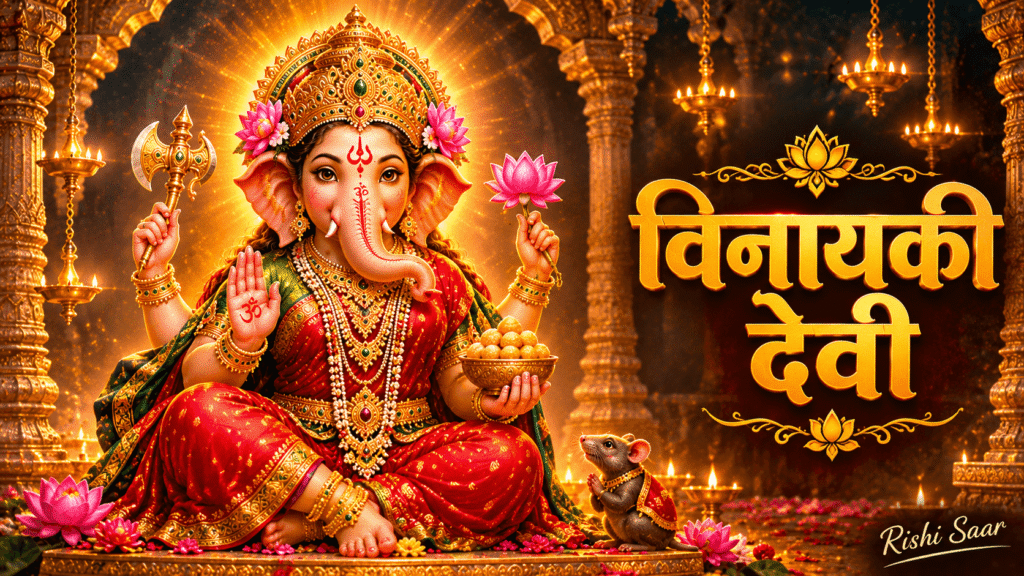
Vinayaki Devi (विनायकी देवी) is a lesser-known elephant-headed goddess in Hinduism, closely associated with Lord Ganesha, the Matrikas (divine mother goddesses), and the 64 Yoginis. She is also known as Vainayaki, Ganeshani, and Ganeshvari in different religious and artistic traditions.
Because of her elephant head and feminine appearance, Vinayaki is frequently described as the female form or Shakti of Lord Ganesha. However, her identity is more complex than this description suggests.
Unlike many goddesses whose stories are preserved in detailed Puranic narratives, Vinayaki appears primarily in lists of divine mothers, Yogini traditions, and temple sculptures.
One of her clearest textual references occurs in the Matsya Purana, Chapter 179, Verse 18, which names Vainayaki among the divine mothers created during Lord Shiva’s battle with the demon Andhaka.
In this Rishi Saar article, we explore Vinayaki Devi’s scriptural references, connection with Ganesha, traditional story, iconography, mantra, and worship, while distinguishing established textual information from later interpretations.
Who Is Vinayaki Devi in Hinduism?
Vinayaki Devi is an elephant-headed female deity associated with Shakti worship in Hinduism.
Her name is closely related to Vinayaka, one of the well-known names of Lord Ganesha. The feminine form Vainayaki can indicate a goddess associated with Vinayaka.
She is commonly recognized through three religious contexts.
As a Shakti associated with Ganesha: Some traditions understand Vinayaki as the feminine manifestation of the divine power represented by Lord Ganesha.
As a Matrika: She appears in traditions involving groups of mother goddesses, although she is not consistently included in the standard group of seven Matrikas.
As a Yogini: Elephant-headed female deities identified with Vinayaki occur in medieval Yogini traditions and temple sculptures.
These identities are related, but they should not automatically be treated as identical in every scripture.
Research by scholar Cecilia Policardi, published in 2023, discusses how the elephant-headed goddess developed from an independently recognized female deity into a figure increasingly associated with Ganesha.
This helps explain why Vinayaki is represented differently across historical sources.
Is Vinayaki Devi the Shakti Form of Lord Ganesha?
Vinayaki Devi is often worshipped or interpreted as the Shakti form of Lord Ganesha, but this association requires an important distinction.
In Hindu religious philosophy, Shakti refers to divine energy, power, or creative potency. Several deities are associated with feminine manifestations of their powers.
For example, Vaishnavi is associated with Vishnu, and Brahmani with Brahma in Matrika traditions.
Similarly, Vinayaki or Ganeshani is understood in certain traditions as the feminine power associated with Ganesha.
Her elephant head reinforces this connection.
However, the Matsya Purana places Vainayaki among the divine mothers created by Shiva during the battle against Andhaka. The passage does not explicitly describe her as a female incarnation created from Ganesha’s body.
This difference matters.
Calling Vinayaki the Shakti of Ganesha is a recognized religious interpretation, but claiming that every Hindu scripture identifies her exclusively as Ganesha’s feminine incarnation would be inaccurate.
Vinayaki also appears within the broader history of independent mother goddesses and Tantric Yogini worship.
Therefore, the most accurate description is that Vinayaki Devi is an elephant-headed goddess who is associated with Ganesha’s Shakti in certain Hindu traditions, while also possessing an identity of her own.
Vinayaki Devi Story in the Matsya Purana
One of the earliest important Puranic references to Vainayaki appears in the Matsya Purana, Chapter 179.
The chapter narrates the conflict between Lord Shiva and Andhakasura, a powerful demon.
The Battle Between Lord Shiva and Andhakasura
According to the Matsya Purana, Andhaka developed a desire to possess Goddess Parvati.
This led to a fierce confrontation with Lord Shiva.
During the battle, Shiva attacked Andhaka with his divine weapon. However, the demon possessed an extraordinary ability: blood falling from his body gave rise to additional forms of Andhaka.
Consequently, the battle became increasingly difficult as numerous demons appeared.
To overcome this problem, Shiva created a large group of divine mothers capable of consuming the demons’ blood.
The names of these goddesses are recorded in the chapter.
Among them appears Vainayaki.
Vainayaki in Matsya Purana Chapter 179, Verse 18
The relevant Sanskrit passage reads:
वैनायकी च वैताली उन्मत्ता उदुम्बरी तथा।
This line identifies Vainayaki alongside Vaitali, Unmatta, and Udumbari.
Scriptural reference: Matsya Purana, Chapter 179, Verse 18.
The passage is significant because it establishes Vainayaki’s presence within the Puranic tradition of divine mother goddesses.
The chapter also describes how the mothers participated in the battle by consuming the blood of the multiplying demons.
Eventually, Vishnu manifested Shushka-Revati, who helped bring the multiplication of the Andhakas to an end.
What Does This Story Tell Us About Vinayaki Devi?
The Matsya Purana establishes Vainayaki as part of Shiva’s divine assembly of mothers.
However, the chapter does not provide a separate account explaining how she obtained an elephant head.
It also does not describe her appearance, vehicle, or individual worship procedure.
Therefore, stories claiming that Ganesha personally created Vinayaki during this battle should not be presented as direct statements from Matsya Purana 179 without additional textual evidence.
Vinayaki Devi and the 64 Yoginis in the Skanda Purana
Vinayaki is closely associated with the Yogini traditions of Hinduism.
Yoginis are groups of female divine beings found in Shakta and Shaiva literature, particularly in Tantric traditions.
One important source is the Skanda Purana, Kashi Khanda, Purvardha, Chapter 45.
This chapter describes the arrival of the 64 Yoginis in Kashi.
In Verses 34–41, the text enumerates their names.
The first goddess named in this particular list is Gajanana (गजानना), meaning the elephant-faced female deity.
Because of this name and its iconographic meaning, Gajanana is frequently discussed alongside Vinayaki.
However, scholars caution that the names Gajanana, Vinayaki, and Ganeshvari cannot automatically be assumed to identify precisely the same deity in every historical text.
The Skanda Purana therefore provides important evidence for an elephant-faced goddess within the 64 Yogini tradition, rather than definitive proof that every Gajanana reference concerns Vinayaki.
The chapter also describes the religious importance of worshipping the Yoginis at Kashi.
Scriptural reference: Skanda Purana, Kashi Khanda, Purvardha, Chapter 45, particularly Verses 34–41.
Different Names of Vinayaki Devi
The elephant-headed goddess is known by several names across Sanskrit literature, religious traditions, and art-historical studies.
Vinayaki (विनायकी): A familiar name for the elephant-headed goddess associated with Vinayaka.
Vainayaki (वैनायकी): The spelling specifically found in Matsya Purana 179.18.
Ganeshani (गणेशानी): A feminine name associating the goddess with Ganesha.
Ganeshvari (गणेश्वरी): A name found in certain Yogini-related traditions.
Gajanana (गजानना): Literally “elephant-faced,” appearing among the 64 Yoginis in the Skanda Purana.
Stri Ganesha: A descriptive expression meaning “female Ganesha,” commonly used to discuss her appearance.
Names such as Gajamukhi and Vighneshvari are also used in devotional explanations of the goddess.
Nevertheless, similar meanings do not necessarily establish that all these names originally referred to one identical deity.
The interpretation depends on the particular scripture, sculpture, or religious tradition under discussion.
Vinayaki Devi Appearance and Symbolism
Vinayaki Devi possesses one of the most distinctive appearances among Hindu female deities.
Her most recognizable characteristic is an elephant head attached to a feminine human body.
Historical sculptures generally represent her with two or four arms, although artistic variations exist.
Her hands may hold objects resembling those associated with Ganesha, including an elephant goad (ankusha), a broken tusk, a bowl of sweets, or a lotus.
Some sculptures depict her standing, while others show her seated in lalitasana, a relaxed posture commonly used in Indian religious art.
She may also wear elaborate ornaments, a crown, necklaces, bracelets, and a decorated lower garment.
Meaning of Her Iconographic Attributes
The following meanings are general devotional interpretations rather than explanations explicitly supplied in Matsya Purana 179.
Elephant head: Commonly interpreted as a symbol of strength, intelligence, and the ability to overcome difficulties, particularly through her association with Ganesha.
Ankusha: An elephant goad, often interpreted as a symbol of control and guidance.
Lotus: Widely associated with purity and spiritual development in Hindu iconography.
Bowl of sweets: An attribute that visually connects some Vinayaki images with Ganesha’s familiar iconography.
Feminine body: Expresses her identity as a goddess and contributes to her association with mother-goddess traditions.
Archaeological studies demonstrate that no single image represents every historical form of Vinayaki.
For example, Aparajita Morde’s 2020 study, Iconographic Depiction of Vinayaki at Yogini Temples, examines different sculptural representations from Odisha, Madhya Pradesh, and Maharashtra.
Is Vinayaki Devi One of the Ashta Matrikas?
Vinayaki is associated with Matrika worship, but her position among the divine mothers varies.
The traditional seven Matrikas, or Saptamatrikas, are generally identified as Brahmani, Maheshvari, Kaumari, Vaishnavi, Varahi, Indrani, and Chamunda, although regional variations occur.
Some expanded Matrika traditions recognize eight or nine mothers.
Within certain traditions, Vinayaki or Ganeshani is included as an additional Matrika.
She is therefore associated with Ashta Matrika or Nava Matrika groupings in some regional devotional systems.
However, she is not uniformly recognized as one of the original seven mothers in every classical list.
This distinction is particularly relevant when comparing Puranic texts with temple sculpture.
Religious images sometimes incorporate additional goddesses who are absent from the best-known literary lists.
Vinayaki’s appearance among other Matrikas in temple panels demonstrates how religious traditions developed and incorporated additional forms of divine feminine power.
Ancient Vinayaki Devi Sculptures and Temples in India
Vinayaki Devi’s historical significance is supported not only by Sanskrit literature but also by surviving archaeological sculptures.
Female elephant-headed figures have been identified at several important religious sites.
Hirapur Chausath Yogini Temple, Odisha
The Chausath Yogini Temple at Hirapur, near Bhubaneswar, is one of India’s important surviving Yogini shrines.
The temple is generally dated to the ninth century CE.
Its sculptures include an elephant-headed goddess identified in scholarly discussions with Vinayaki.
The temple’s circular design and collection of female deities reflect the historical importance of Yogini worship.
Bhedaghat Chausath Yogini Temple, Madhya Pradesh
The Chausath Yogini Temple at Bhedaghat, near Jabalpur, contains an important collection of Yogini sculptures.
An elephant-headed female figure associated with Vinayaki forms part of the site’s iconographic history.
Such sculptures demonstrate her presence within medieval Yogini traditions.
Bhuleshwar Temple, Maharashtra
The Bhuleshwar Temple near Yavat in Maharashtra also contains sculptural representations identified as Vinayaki.
Art-historical research describes her alongside other mother goddesses.
These images are particularly useful for understanding how Vinayaki was integrated into broader Matrika iconography.
Other Sculptural Evidence
Additional elephant-headed female images have been studied from sites including Hinglajgarh, Pateshwar, and areas around Morena.
A 2023 scholarly study by Cecilia Policardi also discusses earlier elephant-headed female representations from Mathura and Rairh in Rajasthan.
However, the identification and historical relationship of the earliest images with later Vinayaki worship remain subjects of academic interpretation.
Together, these findings confirm that elephant-headed female divinities formed part of Indian religious art long before modern popular interest in Vinayaki.
Vinayaki Devi Mantra in Sanskrit
A name-based invocation of Vainayaki appears in published Sarvatobhadra Mandala worship procedures.
Sanskrit Mantra:
ॐ भूर्भुवः स्वः वैनायक्यै नमः॥
English Transliteration:
Om Bhur Bhuvah Svah Vainayakyai Namah.
Meaning:
A respectful invocation offering salutations to Goddess Vainayaki.
The essential name-based salutation is:
ॐ वैनायक्यै नमः॥
Om Vainayakyai Namah.
This is an attested form of Sanskrit ritual salutation, but it should not be described as a secret Tantric mantra from the Matsya Purana.
Neither Matsya Purana 179.18 nor the cited passage of the Skanda Purana provides this exact formula as an exclusive Vinayaki mantra.
Devotees following a particular Tantric lineage should use the mantras and procedures prescribed by their qualified teacher.
How to Worship Vinayaki Devi at Home
Because Vinayaki’s worship differs across regional and Tantric traditions, there is no single household puja procedure established by the cited Puranic passages.
However, devotees wishing to offer simple, respectful prayers may follow a general method of Hindu goddess worship.
Begin by cleaning the worship area and placing an image of Vinayaki Devi in a suitable location.
Light a small ghee or oil lamp, observing appropriate fire safety.
Offer fresh flowers, clean water, or fruit according to personal and family customs.
Devotees may recite a simple salutation to Vainayaki or pray in their own language.
Meditation on the goddess’s form can also be included as an act of devotion.
Conclude by expressing gratitude and offering prayers for wisdom, strength, and the ability to overcome difficulties.
Important: This is a suggested form of simple devotional worship, not a ritual procedure quoted from the Matsya Purana.
Specialized Yogini worship may involve initiation, mandalas, prescribed mantras, and elaborate Tantric procedures. These should not be improvised from incomplete internet instructions.
What Are the Traditional Benefits of Vinayaki Devi Worship?
Within devotional interpretations that connect Vinayaki with Ganesha, devotees associate her worship with the removal of obstacles, wisdom, protection, and divine grace.
Her presence among the divine mothers in the Andhaka narrative also connects her with the protective power of Shakti.
However, the relevant verse of the Matsya Purana does not contain a separate phala-shruti, or declaration of specific benefits, for individual Vinayaki worship.
Consequently, claims that her worship guarantees wealth, marriage, pregnancy, immediate success, or the cure of diseases cannot be attributed to that passage.
Devotees may sincerely pray to her for well-being and guidance without treating these hoped-for blessings as guaranteed results.
Her religious significance is best appreciated through the interconnected traditions of Shakti, divine motherhood, and the elephant-headed deity’s association with Ganesha.
Why Is Vinayaki Devi Important in Hindu Shakti Traditions?
Vinayaki Devi offers an important example of the diversity of Hindu goddess worship.
Her identity cannot be understood through one story or one theological framework alone.
In the Matsya Purana, she appears as Vainayaki, one of the mothers involved in Shiva’s confrontation with Andhaka.
In medieval Tantric and Yogini traditions, elephant-headed female figures appear among groups of powerful goddesses.
In iconographic and some devotional traditions, she becomes associated with Ganesha and his feminine divine power.
Her sculptures also demonstrate that Hindu religious art included divine feminine manifestations beyond the most familiar forms of Durga, Lakshmi, Saraswati, and Parvati.
For readers exploring Hindu mythology through Rishi Saar, Vinayaki provides an example of why historical images, Sanskrit texts, and regional worship traditions should be studied together rather than forcing every reference into a single account.
Authentic Scriptural and Research References
The following sources support the information presented in this article.
- Matsya Purana, Chapter 179 — The battle with Andhaka and the divine mothers, including Vainayaki in Verse 18.
- Skanda Purana, Kashi Khanda, Chapter 45 — The 64 Yoginis, including Gajanana in Verses 34–41.
- Iconographic Depiction of Vinayaki at Yogini Temples — Aparajita Morde, Heritage: Journal of Multidisciplinary Studies in Archaeology, Volume 8.1, 2020, pages 721–729.
- Variations on the Elephantine Theme: Jyeshtha-Vinayaki, from Independent Goddess to Ganesha’s Female Form — Cecilia Policardi, 2023, pages 223–264. A scholarly study of the textual and historical development of the elephant-headed goddess.
- Chausath Yogini Temples — UNESCO World Heritage Centre — Information concerning the historical and architectural significance of Yogini temple sites. These sites appear on India’s UNESCO Tentative List; that does not mean all have received World Heritage inscription.
- Sarvatobhadra Mandala Puja — A published ritual procedure containing the salutation to Vainayaki.
Conclusion
Vinayaki Devi is an important but comparatively less familiar goddess whose history reflects the rich diversity of Hindu Shakti traditions.
The Matsya Purana explicitly names Vainayaki among the divine mothers, while the Skanda Purana preserves the name Gajanana within a list of 64 Yoginis.
Historical sculptures provide further evidence for the worship and representation of elephant-headed female divinities in different parts of India.
Although Vinayaki is frequently described as the female form or Shakti of Lord Ganesha, her historical identity extends beyond that single interpretation.
She also belongs to the wider traditions of Matrika worship, Tantric goddesses, and sacred Indian iconography.
Understanding these distinctions makes it possible to appreciate Vinayaki Devi’s religious significance while remaining faithful to the available scriptures and historical evidence.
Next read: Varahi Amman: Story, Legend, Worship & Mantra
Frequently Asked Questions About Vinayaki Devi
1. Is Vinayaki Devi the Wife of Lord Ganesha?
Vinayaki Devi should not automatically be identified as Lord Ganesha’s wife. The description “female form of Ganesha” refers to her feminine iconography or her association with his Shakti in certain traditions. This is different from the concept of a consort. Ganesha’s marital traditions vary, with Siddhi and Buddhi among the figures identified as his consorts in some traditions. The Matsya Purana does not describe Vainayaki as his wife.
2. Why Does Vinayaki Devi Have Different Animal Mounts in Sculptures?
Historical representations of Vinayaki do not follow one uniform iconographic pattern. Some images associate her with a mouse, reflecting her connection with Ganesha, while other elephant-headed female figures appear with different animals, including a donkey. Scholars have also examined connections between certain elephant-faced goddesses and Jyeshtha. These variations suggest that different regional and religious traditions influenced the development and identification of her images.
3. Is Vinayaki Devi Mentioned in the Devi Mahatmya or Durga Saptashati?
The Devi Mahatmya, also known as the Durga Saptashati, describes several powerful manifestations of the Goddess, including the Matrikas in Chapter 8. However, it does not explicitly name Vinayaki among those goddesses. Therefore, readers should not cite the Durga Saptashati as a direct source for a distinct Vinayaki Devi story. Her name is more directly attested in texts such as the Matsya Purana.
4. Is There a Specific Festival or Fasting Day Dedicated to Vinayaki Devi?
There is no single universally recognized Hindu festival dedicated exclusively to Vinayaki Devi comparable to the widely celebrated Ganesha Chaturthi. Her worship may be incorporated into Matrika, Yogini, or regional goddess traditions. Specific days and rituals depend on the lineage or temple involved. It would therefore be inaccurate to prescribe a universally mandatory Vinayaki fast without identifying the religious tradition that follows it.

