
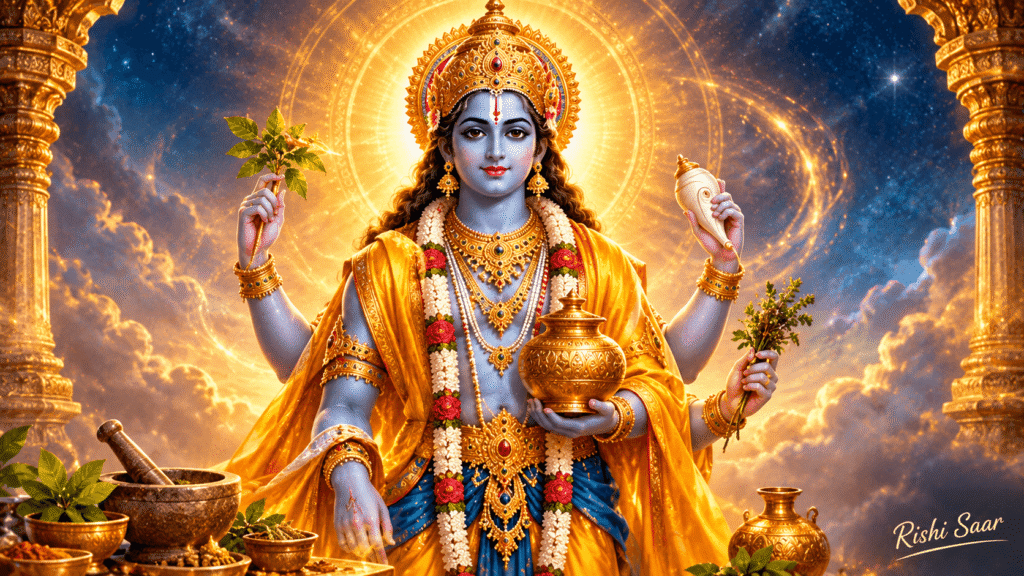
In Hindu tradition, health is considered one of life’s greatest blessings, and few deities represent this belief as closely as Lord Dhanvantari. Revered as the God of Ayurveda, medicine, and healing, he is the divine physician of the gods and a manifestation of Lord Vishnu.
His story begins with one of Hindu mythology’s most remarkable events, the Samudra Manthan, when the gods and demons churned the cosmic ocean in search of immortality. From its depths emerged Lord Dhanvantari, carrying a vessel filled with Amrita, the nectar of immortality.
But Dhanvantari’s significance extends beyond this extraordinary appearance. He is closely associated with Ayurveda, the ancient Indian system of medicine, and with the medical teachings preserved in the Sushruta Samhita. His worship also forms an important part of Dhanteras, a festival that celebrates not only prosperity but also health and longevity.
In this article, Rishi Saar explores the mythology, scriptural references, Ayurvedic history, worship practices, and mantras associated with Lord Dhanvantari.
Who Is Lord Dhanvantari, the God of Ayurveda?
Lord Dhanvantari is the Hindu deity of medicine and healing, traditionally regarded as the divine originator and protector of Ayurveda. He is known as the physician of the Devas and is worshipped for good health, longevity, and protection from illness.
His divine identity is explicitly described in the Srimad Bhagavatam, also known as the Bhagavata Purana.
In Bhagavata Purana, Canto 8, Chapter 8, Verse 34, Dhanvantari is identified as a manifestation of Lord Vishnu and described as possessing knowledge of Ayurvedic medicine.
The verse reads:
स वै भगवतः साक्षाद्विष्णोरंशांशसम्भवः।
धन्वन्तरिरिति ख्यात आयुर्वेददृगिज्यभाक्॥
Sa vai bhagavataḥ sākṣād viṣṇor aṁśāṁśa-sambhavaḥ,
Dhanvantarir iti khyāta āyur-veda-dṛg ijya-bhāk.
Meaning: The verse identifies Dhanvantari as a manifestation of Lord Vishnu, renowned for his knowledge of the science of medicine.
This reference establishes his religious association with both Lord Vishnu and Ayurveda.
Although commonly called the God of Ayurveda, Dhanvantari’s importance is not limited to any single branch of medicine. He represents the broader ideals of preserving life, relieving suffering, and using knowledge for the welfare of humanity.
His name is also written as Dhanvantar, Dhanwantri, Dhanwantari, and Dhanwanthari in different regional and transliteration traditions.
How Was Lord Dhanvantari Born During Samudra Manthan?
The origin of Lord Dhanvantari is connected to Samudra Manthan, the legendary churning of the Ocean of Milk.
The story appears in the Bhagavata Purana, Canto 8, and the Vishnu Purana, Book 1, Chapter 9, although some details differ between the accounts.
The Search for Amrita
According to the legend, the Devas and Asuras sought Amrita, a divine nectar that could grant immortality.
To obtain it, they agreed to churn the Ocean of Milk.
Mount Mandara was used as the churning rod, and Vasuki, the great serpent, served as the rope. Lord Vishnu supported the mountain in his Kurma, or tortoise, incarnation, preventing it from sinking into the ocean.
As the churning continued, several extraordinary treasures and beings appeared, including the celestial elephant Airavata, the Kaustubha jewel, and Goddess Lakshmi.
The ocean also produced the deadly poison Halahala, which Lord Shiva consumed to protect creation.
Eventually, another magnificent figure emerged from the waters.
He was Lord Dhanvantari.
The Divine Appearance of Dhanvantari
The Bhagavata Purana (8.8.31–33) describes a youthful, powerful figure with a dark complexion, broad chest, strong arms, beautiful ornaments, and yellow garments.
In his hands, he carried a vessel filled with Amrita.
The Vishnu Purana (1.9) also records Dhanvantari emerging with the nectar, although it describes him wearing white garments. Such differences reflect variations between Puranic narratives.
The Asuras subsequently seized the nectar. Lord Vishnu then assumed the enchanting form of Mohini and arranged for the Amrita to be distributed among the Devas.
Dhanvantari’s appearance became deeply symbolic in Hindu tradition.
While Amrita represents immortality in the mythological narrative, Dhanvantari’s association with it also symbolizes vitality, preservation of life, and the importance of healing.
The story connects divine wisdom with one of humanity’s most fundamental desires: to live a healthy and meaningful life.
What Does Lord Dhanvantari Hold in His Four Hands?
Lord Dhanvantari is commonly depicted as a four-armed deity adorned with a crown, ornaments, and yellow or golden garments.
His appearance resembles that of Lord Vishnu, reflecting their theological connection.
The objects associated with his hands carry different meanings.
The Amrita Kalasha (Pot of Nectar): This is Dhanvantari’s most distinctive symbol. It represents immortality in Hindu mythology and is associated with health, longevity, and the preservation of life.
The Shankha (Conch Shell): The conch is one of Lord Vishnu’s traditional attributes. It symbolizes auspiciousness, purity, and divine protection.
The Sudarshana Chakra (Divine Discus): Some images show Dhanvantari holding Vishnu’s discus, which represents divine order, protection, and the destruction of harmful forces.
Medicinal Herbs or Ayurvedic Scriptures: Other depictions include healing plants or a medical text, symbolizing Dhanvantari’s relationship with Ayurveda and medical knowledge.
The arrangement of these objects varies across temples and artistic traditions. Notably, the Bhagavata Purana’s description of his emergence specifically emphasizes the Amrita vessel; it does not prescribe every detail of the familiar four-armed image.
Each representation highlights a different aspect of Dhanvantari’s identity as a divine protector and healer.
History of Ayurveda: How Is Lord Dhanvantari Connected to Ancient Medicine?
Ayurveda is among the world’s oldest surviving traditional medical systems, and Lord Dhanvantari is widely revered as its divine founder.
The word Ayurveda comes from two Sanskrit terms:
- Ayus: Life or lifespan
- Veda: Knowledge or understanding
Ayurveda is therefore commonly translated as the knowledge of life.
Its classical teachings encompass diet, daily routines, diagnosis, therapeutic practices, medicinal substances, and approaches to maintaining health.
The Traditional Origin of Ayurveda
According to Ayurvedic tradition, medical knowledge was preserved and transmitted through a lineage of divine and human teachers.
Different classical accounts describe this transmission differently, but they share the understanding that medicine should be used to protect living beings and relieve suffering.
Dhanvantari occupies an especially important place in the tradition associated with surgery.
Dhanvantari, Divodasa, and the Sushruta Samhita
One of the strongest literary connections between Dhanvantari and Ayurveda is found in the Sushruta Samhita, Sutrasthana, Chapter 1, known as Vedotpatti Adhyaya, the chapter concerning the origin of medical knowledge.
The text introduces Divodasa Dhanvantari, the king of Kashi, as a teacher of Ayurveda.
Several sages, including Sushruta, approach him because they are distressed by the suffering caused by disease and injury.
They request medical knowledge so that they can help humanity.
Divodasa agrees to teach them.
This scene is significant because it presents the purpose of medicine as something greater than personal knowledge or professional accomplishment. The central motivation is the relief of suffering.
The Sushruta Samhita became one of the most important Sanskrit works associated with surgery, anatomy, surgical instruments, and medical training.
Its traditional connection with Dhanvantari is particularly important to Shalya Tantra, the surgical branch of Ayurveda.
How Ayurveda Developed Over Time
Although Hindu religious tradition regards Dhanvantari as the father of Ayurveda, the historical development of Ayurvedic medicine involved many generations of scholars and physicians.
Three particularly influential Sanskrit medical works are:
- Charaka Samhita: Known especially for teachings on internal medicine, diagnosis, diet, and treatment.
- Sushruta Samhita: Particularly associated with surgery, anatomy, wounds, and surgical procedures.
- Ashtanga Hridaya: Attributed to Vagbhata, it presents Ayurvedic principles and clinical teachings in an organized form.
Classical Ayurveda also recognizes eight branches, covering areas such as internal medicine, surgery, pediatrics, toxicology, diseases of the eyes and other sensory organs, rejuvenation, and reproductive health.
These texts developed through long processes of composition, compilation, and commentary. Their precise chronology remains a subject of historical scholarship.
The divine accounts of Dhanvantari are therefore best understood as part of Ayurveda’s religious and intellectual heritage, rather than as a complete, independently verified history of its development.
Why Is Lord Dhanvantari Worshipped on Dhanteras?
Dhanteras is popularly associated with buying gold, silver, utensils, and other auspicious objects. However, its significance is not limited to wealth.
The festival is also closely connected with Lord Dhanvantari and the importance of good health.
Dhanteras, also called Dhantrayodashi, falls on the thirteenth lunar day of the waning moon during the Hindu month of Kartika. It marks an important occasion in the Diwali festival period.
According to Hindu tradition, Dhanvantari emerged from the Ocean of Milk on this auspicious occasion. For this reason, Dhanteras is also celebrated as Dhanvantari Jayanti.
Why Health and Wealth Are Celebrated Together
On Dhanteras, Goddess Lakshmi and Lord Kubera are worshipped in connection with prosperity and abundance.
Lord Dhanvantari, meanwhile, represents health, healing, and longevity.
This combination gives the festival a deeper meaning.
Wealth may provide comfort and security, but health is equally essential to enjoying life. Dhanvantari’s presence in the festival reminds devotees that prosperity includes physical and mental well-being.
Ayurvedic practitioners, students, and institutions often observe Dhanvantari Jayanti through prayers, ceremonial worship, and activities celebrating the heritage of Ayurveda.
For devotees, the occasion is an opportunity to pray not only for personal well-being but also for the recovery and health of family members and others experiencing illness.
How to Worship Lord Dhanvantari at Home?
Lord Dhanvantari can be worshipped at home through a simple puja, the offering of flowers and fruit, and the chanting of his mantra. Elaborate ceremonies are not necessary for personal devotion.
Although Dhanteras is a particularly auspicious occasion, devotees may offer prayers to Dhanvantari throughout the year.
Simple Lord Dhanvantari Puja Vidhi
- Prepare the worship area. Clean a suitable space in your home and place an image or idol of Lord Dhanvantari on the altar.
- Light a diya. Offer a lamp with oil or ghee, following your family’s customary worship practices. The flame should be placed safely away from flammable materials.
- Offer flowers, water, and fruit. Fresh flowers, clean water, and simple vegetarian offerings may be presented as symbols of respect and devotion.
- Chant the Dhanvantari mantra. Recite “Om Dhanvantaraye Namah” or another traditional Dhanvantari invocation. Devotees sometimes repeat the mantra 11, 21, or 108 times, although there is no universal compulsory count for simple home worship.
- Pray for health and well-being. Offer prayers for yourself, your family, people experiencing illness, and those who care for them.
- Conclude with gratitude. Bow before the deity and conclude the puja according to your household tradition.
When Is the Best Time to Worship Lord Dhanvantari?
Devotees may worship Lord Dhanvantari during their regular morning or evening prayers.
Dhanteras is the most prominent annual occasion connected with his worship, but there is no single mandatory time for all forms of personal devotion.
Specific temples and religious lineages may follow their own auspicious timings and ceremonial procedures.
For daily worship, sincerity and regularity are more important than performing an elaborate ritual.
Lord Dhanvantari Mantra and Benefits
The Lord Dhanvantari mantra is a sacred devotional invocation used by Hindus to seek blessings for health, protection, and longevity.
Two widely used forms are the short Dhanvantari Moola Mantra and a longer invocation addressed to Dhanvantari as a manifestation of Lord Vishnu.
1. Lord Dhanvantari Moola Mantra
Sanskrit:
ॐ धन्वन्तरये नमः॥
English Transliteration:
Om Dhanvantaraye Namah.
Meaning:
“Salutations to Lord Dhanvantari.”
This simple mantra can be included in daily prayers and is particularly suitable for devotees who prefer a short invocation.
2. Lord Dhanvantari Mantra for Health and Healing
Sanskrit:
ॐ नमो भगवते वासुदेवाय धन्वन्तरये अमृतकलशहस्ताय।
सर्वामयविनाशनाय त्रैलोक्यनाथाय श्री महाविष्णवे नमः॥
English Transliteration:
Om Namo Bhagavate Vasudevaya Dhanvantaraye Amrita Kalasha Hastaya, Sarvamaya Vinashanaya Trailokyanathaya Shri Mahavishnave Namah.
Meaning:
“Salutations to Lord Dhanvantari, the divine manifestation of Vasudeva, who holds the pot of Amrita, who is invoked as the remover of ailments, who is the Lord of the three worlds, and who is Shri Mahavishnu.”
This form of the mantra is used in contemporary Hindu worship and is published by the Hindu Temple Society of North America. Its precise origin in an ancient Sanskrit scripture is not securely established, so it should not automatically be identified as a verse from the Vedas or Puranas.
What Are the Benefits of Chanting the Dhanvantari Mantra?
In Hindu devotional tradition, chanting Lord Dhanvantari’s mantra is associated with several spiritual and personal benefits.
Prayers for Good Health: Dhanvantari is worshipped as the divine physician, and devotees invoke his blessings when praying for health, recovery, and longevity.
Mental Peace and Spiritual Comfort: Chanting with attention and devotion may provide a calming routine and offer emotional reassurance during difficult periods.
Greater Spiritual Discipline: Regular mantra recitation can encourage consistency in prayer, reflection, and personal spiritual practice.
Compassion and Gratitude: Worshipping Dhanvantari can remind devotees of the importance of caring for those who are ill and respecting the knowledge and efforts of medical professionals.
These benefits are rooted in devotional belief and personal spiritual experience. There is no established scientific evidence that chanting a Dhanvantari mantra can cure a specific disease.
Prayer may provide comfort alongside treatment, but it should not replace medical diagnosis, prescribed medicines, or professional healthcare.
What Does Lord Dhanvantari Teach Us About Healing Today?
Lord Dhanvantari’s story continues to hold significance because it brings together three important ideas: knowledge, compassion, and responsibility.
The Sushruta Samhita provides a particularly meaningful example. Its opening narrative describes sages seeking medical instruction because they are moved by the suffering of others.
That concern for human well-being remains relevant today.
Dhanvantari is therefore more than a figure associated with ancient medical knowledge. For devotees and Ayurvedic practitioners, he represents the moral responsibility that accompanies the healing profession.
His presence in Ayurvedic institutions and temples reflects the continuing cultural importance of this tradition.
However, appreciating Ayurveda’s historical heritage does not mean that every traditional treatment has been scientifically proven effective.
Modern research has evaluated certain Ayurvedic interventions, but the strength of clinical evidence varies considerably. The US National Center for Complementary and Integrative Health also warns that some Ayurvedic preparations may contain harmful levels of substances such as lead, mercury, or arsenic.
Anyone considering Ayurvedic medicines, particularly for a serious or ongoing health condition, should consult a qualified healthcare professional.
Respect for healing traditions and careful attention to medical evidence can coexist.
In this sense, Dhanvantari’s lasting significance is found in the principle that medical knowledge should be used thoughtfully, responsibly, and for the benefit of others.
Frequently Asked Questions About Lord Dhanvantari
Who Is Lord Dhanvantari’s Wife?
Arogya Lakshmi is considered the divine consort of Lord Dhanvantari in some devotional traditions. However, the major Samudra Manthan account in the Bhagavata Purana (8.8.31–34) does not identify a wife for him.
Because Dhanvantari is regarded as a manifestation of Vishnu, some traditions also connect him with Goddess Lakshmi. These associations should not be confused with a universally documented marriage narrative, since Hindu texts and regional traditions differ.
Did Lord Dhanvantari Have a Son?
Yes. The Bhagavata Purana, Canto 9, Chapter 17, Verses 4–5, presents a royal genealogy in which Dhanvantari is the son of Dirghatama and the father of Ketuman.
Ketuman’s son is named Bhimaratha, and the next generation includes Divodasa.
This genealogy belongs to the Puranic account of the royal lineage associated with Kashi and should be distinguished from the celestial Dhanvantari’s appearance during Samudra Manthan.
Why Is Lord Dhanvantari Sometimes Shown Holding a Leech?
Some traditional images depict Lord Dhanvantari holding a leech to represent the historical use of leech therapy in Ayurvedic medicine.
The Sushruta Samhita, Sutrasthana, Chapter 13, discusses Jalaukavacharana, the application of leeches as a form of bloodletting.
The leech in Dhanvantari’s iconography reflects this classical medical tradition. It does not mean that leech therapy is appropriate for every condition or that it should be attempted without professional medical supervision.
Are Lord Dhanvantari and the Ashwini Kumaras the Same?
No. Lord Dhanvantari and the Ashwini Kumaras are distinct divine figures associated with healing.
The Ashwini Kumaras are twin Vedic deities celebrated for their healing and rescue activities in hymns such as Rigveda 1.116.
Dhanvantari is especially associated with Lord Vishnu, Ayurveda, and the Amrita Kalasha. Although both have connections with medicine, their identities and scriptural narratives are different.
Is Lord Dhanvantari Mentioned in the Vedas?
Dhanvantari’s familiar story of emerging from the Ocean of Milk with Amrita is found in later sacred literature, particularly the Bhagavata Purana and Vishnu Purana, rather than in a hymn of the Rigveda.
Earlier Vedic literature contains important healing traditions, including hymns to the Ashwini Kumaras. References to Dhanvantari also appear in Vedic-associated ritual literature, such as the Kaushika Sutra.
It is therefore important to distinguish Ayurveda’s broader Vedic associations from the specific Puranic narrative of Lord Dhanvantari.
Conclusion: The Eternal Significance of Lord Dhanvantari
Lord Dhanvantari holds a unique place in Hindu tradition as the God of Ayurveda, medicine, and healing.
His emergence during Samudra Manthan represents the sacred value of life, while his association with the Sushruta Samhita connects him with India’s classical medical heritage.
His worship during Dhanteras also offers a meaningful reminder: prosperity is not measured only through material wealth but also through health, wisdom, and the ability to care for others.
From ancient Puranic narratives to modern Ayurvedic institutions, Lord Dhanvantari continues to symbolize the pursuit of healing guided by knowledge and compassion.
At Rishi Saar, these sacred stories are explored not merely as mythology but as enduring parts of India’s religious, cultural, and intellectual heritage.
Dhanvantari’s message remains relevant across generations: the true value of healing knowledge lies in its ability to protect life and relieve suffering.
Explore More: Hanuman’s Son: The Story of Makardhwaja
