Swarna Akarshana Bhairava (स्वर्णाकर्षण भैरव) is a revered form of Lord Bhairava, associated with prosperity, protection, and the removal of poverty in Hindu devotional and Tantric traditions. While Bhairava is often depicted as a fierce manifestation of Lord Shiva, Swarna Akarshana Bhairava is worshipped in a more benevolent, golden form.
Devotees pray to him for financial stability, relief from difficulties, and the ability to lead a prosperous life. However, his significance extends beyond material wealth. The traditional hymns dedicated to him also emphasize divine protection, spiritual devotion, and liberation.
References to Bhairava appear in the Shiva Purana and Skanda Purana, while the specific worship of Swarna Akarshana Bhairava is described in a Sanskrit stotra traditionally attributed to the Rudrayamala Tantra.
Understanding these sources helps distinguish scriptural narratives from later devotional beliefs.
Who Is Swarna Akarshana Bhairava?
Swarna Akarshana Bhairava is a wealth-associated manifestation of Lord Bhairava, who is himself a form of Lord Shiva.
His name consists of three Sanskrit words:
- Swarna (स्वर्ण): Gold.
- Akarshana (आकर्षण): Attraction or drawing towards oneself.
- Bhairava (भैरव): A powerful manifestation of Shiva associated with protection, time, and the destruction of ignorance.
The name can therefore be understood as “Bhairava who attracts gold or prosperity.”
In the Swarna Akarshana Bhairava Stotram, he receives titles such as Daridryakala, the destroyer of poverty, and Dhanadhyaksha, the lord or overseer of wealth.
These descriptions explain why devotees associate him with financial well-being.
However, Hindu devotional tradition does not necessarily regard prosperity as unlimited material accumulation. Wealth can also represent security, the ability to fulfil responsibilities, generosity, and freedom from unnecessary suffering.
Swarna Akarshana Bhairava Story and Origin in Hindu Scriptures
The story of Swarna Akarshana Bhairava is best understood through two related traditions: the Puranic origin of Bhairava and the later hymn describing his golden, prosperity-giving form.
The Origin of Lord Bhairava from Shiva
According to the Shiva Purana, Shatarudra Samhita, Chapter 8, a dispute arose concerning supreme divinity.
Lord Brahma, overcome by pride, proclaimed his own supremacy. Lord Vishnu also entered the discussion, and the two questioned the nature of the highest reality.
When Brahma continued to speak arrogantly, Shiva manifested a brilliant and powerful being named Bhairava.
The Shiva Purana, Shatarudra Samhita 8.44–52, describes Shiva creating Bhairava and assigning him the task of correcting Brahma’s pride.
Bhairava subsequently severed Brahma’s fifth head.
The narrative continues in Chapter 9. Bhairava carried Brahma’s skull and wandered in accordance with the Kapalika vow. Upon reaching Kashi, the skull fell from his hand at the sacred site known as Kapalamochana.
The story represents the destruction of arrogance and the importance of spiritual humility.
A related account appears in the Skanda Purana, Kashi Khanda, Purvardha, Chapter 31.
Important distinction: These Puranic chapters describe Bhairava and Kala Bhairava. They do not independently narrate the separate birth of the golden form known as Swarna Akarshana Bhairava.
The Golden Form of Bhairava
The Swarna Akarshana Bhairava Stotram introduces the deity through a different devotional setting.
Its opening verses present Sage Markandeya asking Nandikeshvara about a sacred hymn dedicated to Bhairava and the spiritual benefits of its recitation.
Nandikeshvara praises the hymn as a source of protection, prosperity, and relief from poverty.
The hymn subsequently describes Bhairava’s golden appearance, divine ornaments, association with Goddess Bhairavi, and compassionate nature.
Rather than presenting a detailed birth legend, this text establishes Swarna Akarshana Bhairava’s identity through praise, meditation, and worship.
Which Hindu Scripture Mentions Swarna Akarshana Bhairava?
The most direct textual reference is the Swarna Akarshana Bhairava Stotram, which is traditionally associated with the Rudrayamala Tantra.
The available Sanskrit version contains an introductory dialogue, meditation verses, a mantra, and a sequence of forty numbered stotra verses.
Its concluding colophon identifies the composition with the Rudrayamala Tantra and an Ishvara–Dattatreya dialogue. However, the opening features Markandeya and Nandikeshvara.
Because transmitted versions and printed editions differ, the traditional attribution should not be treated as proof of an independently established date of composition.
Several passages are especially relevant:
Stotram, Verse 6: Describes Bhairava as the destroyer of poverty and giver of great prosperity.
Stotram, Verse 18: Addresses him as Dhanadhyaksha, associating him directly with wealth.
Stotram, Verses 25–29: Describe his golden appearance and his connection with the bestowal of gold.
Stotram, Verses 31–40: Present the phala-shruti, or traditional declaration of the benefits of reciting the hymn.
The text is available for study in the Swarna Akarshana Bhairava Stotram Sanskrit edition.
Swarna Akarshana Bhairava Appearance and Symbolism
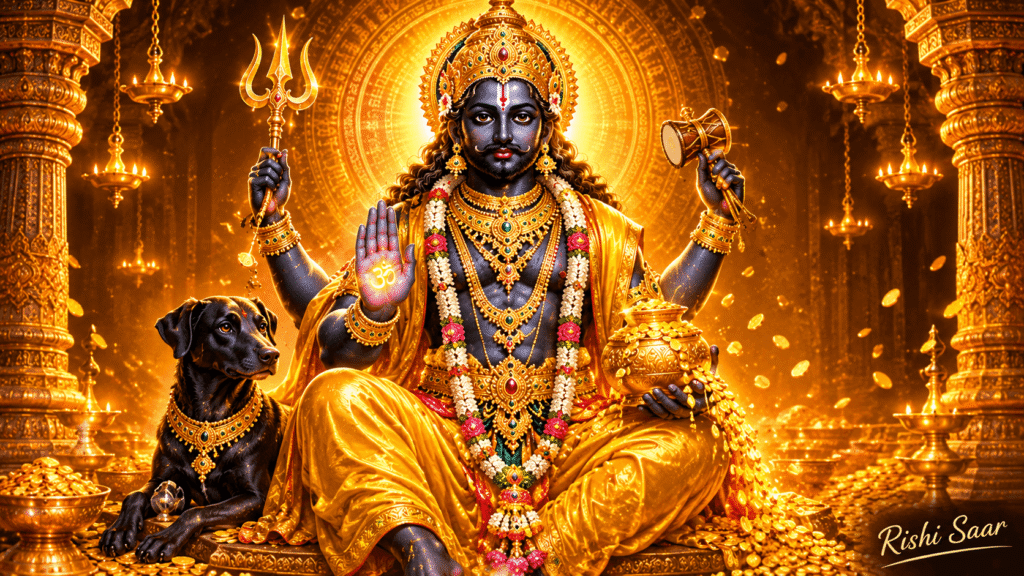
Swarna Akarshana Bhairava has distinctive iconography that separates him from many of Bhairava’s more terrifying depictions.
The traditional meditation verses describe him seated upon a magnificent throne inside a pavilion adorned with precious gems, surrounded by celestial trees.
He is visualized with a complexion resembling molten gold.
The dhyana passage reads:
Sanskrit:
पारिजातद्रुमान्तारे स्थिते माणिक्यमण्डपे।
सिंहासनगतं वन्दे भैरवं स्वर्णदायकम्॥
Meaning:
“I bow to Bhairava, the giver of gold, seated upon a throne within a ruby pavilion among Parijata trees.”
Another meditation verse describes him as three-eyed, accompanied by the Goddess, and holding a vessel, damaru, trident, and boon-granting gesture.
These attributes carry religious symbolism.
The golden complexion represents prosperity and divine radiance. The trident is associated with Shiva’s power, while the damaru signifies his connection with cosmic rhythm and creation.
The vessel of gold reflects abundance, and the boon-granting gesture expresses divine grace.
His association with Bhairavi also emphasizes the connection between Shiva and Shakti.
Individual temple images may differ in their arrangement of arms, ornaments, and accompanying figures.
Swarna Akarshana Bhairava Mantra in Sanskrit and English
Mantra recitation is an important part of Swarna Akarshana Bhairava worship.
Two approaches should be distinguished: a simple devotional salutation and the longer formula transmitted in the Tantric stotra.
1. Simple Swarna Akarshana Bhairava Mantra
Sanskrit:
ॐ स्वर्णाकर्षणभैरवाय नमः॥
English Transliteration:
Om Swarnakarshana Bhairavaya Namah.
Meaning:
“Salutations to Lord Swarna Akarshana Bhairava.”
This is a straightforward name-based invocation suitable for ordinary devotional prayer.
2. Traditional Swarna Akarshana Bhairava Maha Mantra
A longer mantra appears in the transmitted Swarna Akarshana Bhairava Stotram.
Sanskrit:
ॐ ऐं ह्रीं श्रीं ऐं श्रीं आपदुद्धारणाय ह्रां ह्रीं ह्रूं अजामलवद्धाय लोकेश्वराय स्वर्णाकर्षणभैरवाय मम दारिद्र्यविद्वेषणाय महाभैरवाय नमः श्रीं ह्रीं ऐम्॥
The mantra invokes Bhairava as the lord of the worlds, the one who rescues devotees from difficulties, and the deity invoked for the removal of poverty.
It also includes sacred bija syllables, such as Aim, Hrim, and Shrim.
These syllables have specialized meanings within Tantric traditions and should not be reduced to ordinary Sanskrit vocabulary.
Note: The precise wording and pronunciation of this longer mantra vary between published versions. Formal Tantric mantra practice should follow the instructions of a qualified teacher within the relevant tradition.
Swarna Akarshana Bhairava Stotram and Its Meaning
The Swarna Akarshana Bhairava Stotram is a devotional hymn praising Bhairava’s divine qualities.
One of its most significant passages is Verse 6:
Sanskrit:
नमो दारिद्र्यकालाय महासम्पत्प्रदायिने।
श्रीभैरवीसंयुक्ताय त्रिलोकेशाय ते नमः॥६॥
Meaning:
“Salutations to the destroyer of poverty and the giver of great prosperity. Salutations to the Lord of the three worlds, united with Goddess Bhairavi.”
This verse establishes the connection between Bhairava, prosperity, and divine protection.
The concluding verses of the hymn make traditional promises concerning wealth, freedom from difficulties, and spiritual attainments.
Interestingly, Verse 40 also refers to Mahabhairava Sayujya, the attainment of spiritual union or closeness with Mahabhairava.
Thus, the hymn presents a broader religious goal than financial success alone.
Benefits of Worshipping Swarna Akarshana Bhairava
According to the Swarna Akarshana Bhairava Stotram, worship is traditionally associated with several blessings.
Relief from poverty: Verses 4–6 and 32–33 praise Bhairava’s ability to remove deprivation and grant prosperity.
Protection during difficulties: The introductory verses describe him as a deity who removes dangers and obstacles.
Peace and confidence: Verse 10 praises Bhairava as both powerful and peaceful, offering reassurance to devotees.
Spiritual progress: The concluding portion of the hymn connects devotion with purification and liberation.
These benefits belong to the religious teachings and devotional promises of the text. They should not be interpreted as scientifically demonstrated outcomes or guarantees of sudden wealth.
For devotees, regular prayer can also become an opportunity to cultivate patience, gratitude, self-discipline, and a more responsible relationship with money.
How to Worship Swarna Akarshana Bhairava at Home
A simple Swarna Akarshana Bhairava puja can be performed through respectful household worship without undertaking elaborate Tantric ceremonies.
The following is a general devotional method, not a claim that every step is prescribed in the Rudrayamala Tantra.
- Clean the worship area. Choose a peaceful and clean place for prayer. Personal cleanliness and mental attention are important aspects of traditional worship.
- Place an image of Bhairava. Keep a picture or properly installed idol of Swarna Akarshana Bhairava on a suitable altar.
- Light a lamp. A small oil or ghee lamp may be offered as a symbol of reverence and illumination. Observe ordinary fire safety.
- Offer flowers and water. Fresh flowers, clean water, and fruit may be presented according to family custom.
- Recite the mantra. Chant “Om Swarnakarshana Bhairavaya Namah” slowly and attentively. A fixed number of repetitions is not compulsory for simple prayer.
- Offer a sincere prayer. Devotees may pray for financial stability, an honest livelihood, protection from difficulties, and the wisdom to make responsible decisions.
- Conclude with gratitude. Bow before the deity and, where possible, perform an act of generosity or service.
Formal practices involving yantras, complex nyasa procedures, extensive mantra repetition, or fire rituals belong to specialized traditions and are best learned from a competent practitioner.
Best Day and Time to Worship Swarna Akarshana Bhairava
Devotees can offer simple prayers to Swarna Akarshana Bhairava during their regular morning or evening worship.
However, certain occasions are particularly associated with Bhairava devotion.
Kalashtami: The eighth lunar day of the waning fortnight is traditionally dedicated to Bhairava worship.
Kala Bhairava Jayanti: This observance commemorates Bhairava’s manifestation. The Shiva Purana, Shatarudra Samhita 9.63–65, specifically connects Bhairava’s appearance with Krishna Paksha Ashtami in the month of Margashirsha.
Tuesday: The Shiva Purana, Shatarudra Samhita 9.70, also mentions Tuesday in connection with Bhairava worship at Kashi.
These are general Bhairava observances. They do not establish a universally mandatory weekday or hour exclusively for Swarna Akarshana Bhairava.
Individual temples and spiritual lineages may follow different practices.
Swarna Akarshana Bhairava and the Spiritual Meaning of Wealth
The worship of Swarna Akarshana Bhairava raises an important question: what does prosperity mean within Hindu religious thought?
Material stability is a legitimate human concern. Families need resources for food, shelter, education, healthcare, and daily responsibilities.
Yet financial prosperity without wisdom and ethical conduct can create additional difficulties.
The Bhagavad Gita, Chapter 17, Verse 20, describes sattvika dana as charity offered appropriately without expecting something in return.
This provides a useful perspective on wealth: prosperity becomes meaningful when accompanied by responsibility and generosity.
Similar associations between devotion and prosperity appear in other Hindu traditions.
For example, Lord Krishna is worshipped as Sanwaliya Seth in Rajasthan. Readers can explore this connection through Rishi Saar’s article on the history of Sanwaliya Seth Temple in Rajasthan, including the traditions associated with its three Krishna shrines.
Health is another essential aspect of human well-being.
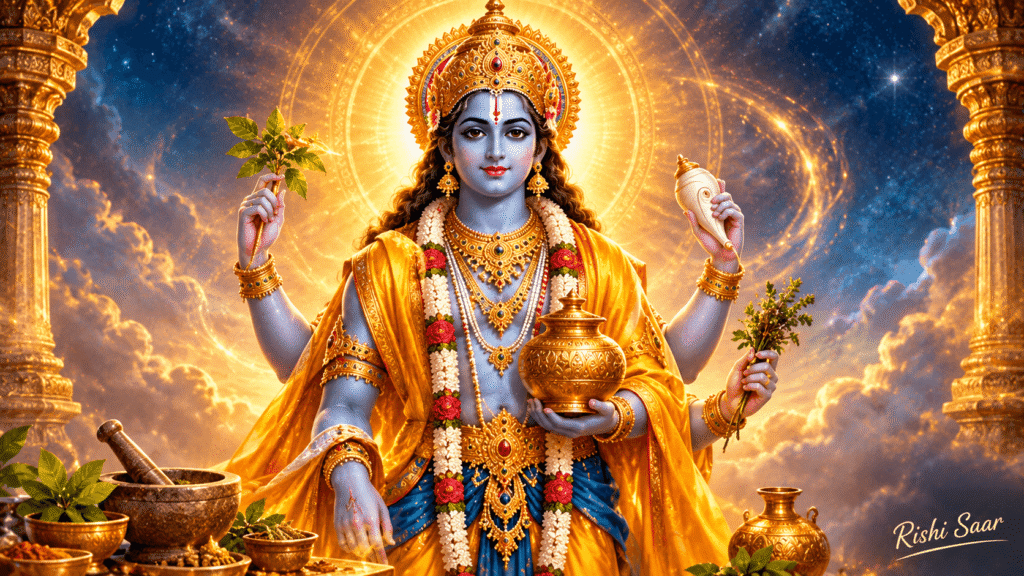
The Bhagavata Purana, Canto 8, Chapter 8, Verses 31–34, describes the appearance of Lord Dhanvantari during Samudra Manthan and identifies his association with Ayurveda.
This wider perspective is explored in Rishi Saar’s guide to Lord Dhanvantari, the Hindu God of Ayurveda.
Together, these traditions illustrate how Hindu devotional life addresses different human needs, including material security, health, and spiritual development.
The distinctive focus of Swarna Akarshana Bhairava remains his golden form and traditional association with the removal of poverty.
Does Swarna Akarshana Bhairava Worship Guarantee Wealth?
The Swarna Akarshana Bhairava Stotram contains strong traditional statements about prosperity and the blessings obtained through recitation.
Such passages are called phala-shruti, meaning descriptions of the spiritual or devotional fruits of a religious composition.
They communicate the faith and theological outlook of the tradition.
However, there is no reliable basis for claiming that chanting a particular mantra will automatically produce money, eliminate debt, or guarantee business success within a specified number of days.
Devotional practice can coexist with budgeting, financial planning, honest work, and seeking professional assistance when necessary.
Understanding this distinction allows the religious significance of the hymn to be respected without turning spiritual practice into an unrealistic financial promise.
Scriptural References and Sources
The following sources provide the textual foundation for this article:
- Shiva Purana, Shatarudra Samhita, Chapter 8: The origin of Bhairava, Shiva’s manifestation, and Brahma’s fifth head.
- Shiva Purana, Shatarudra Samhita, Chapter 9: Bhairava’s journey to Kashi and the traditional observance of Bhairava Ashtami.
- Skanda Purana, Kashi Khanda, Chapter 31: The manifestation and religious significance of Kala Bhairava.
- Swarna Akarshana Bhairava Stotram: The traditionally Rudrayamala-attributed hymn containing the meditation, mantra, praise, and benefits of worship.
- Bhagavad Gita 17.20: The teaching concerning selfless charity and responsible giving.
Textual note: The Swarna Akarshana Bhairava hymn survives in differing published versions. Verse numbers used here refer to the linked SanskritDocuments edition, and textual attribution should not be confused with independently verified historical dating.
Conclusion
Swarna Akarshana Bhairava represents a distinctive form of Lord Bhairava, combining the protective character of Shiva with devotional associations of prosperity and abundance.
His golden iconography, sacred mantra, and traditional stotram have made him especially meaningful to devotees seeking relief from financial difficulties.
The Shiva Purana and Skanda Purana provide the broader religious background of Bhairava, while the Rudrayamala-attributed stotram supplies the specific descriptions of his wealth-associated form.
Ultimately, Swarna Akarshana Bhairava worship can be understood as a prayer for prosperity guided by humility, responsibility, generosity, and spiritual devotion.
Frequently Asked Questions About Swarna Akarshana Bhairava
1. Is Swarna Akarshana Bhairava One of the Eight Ashta Bhairavas?
Swarna Akarshana Bhairava is not ordinarily listed among the eight principal Ashta Bhairavas. A widely recognized group consists of Asitanga, Ruru, Chanda, Krodha, Unmatta, Kapala, Bhishana, and Samhara. These forms are associated with the protection of the eight directions. Swarna Akarshana Bhairava is worshipped as another manifestation of Bhairava, particularly associated with prosperity. Lists of Bhairava manifestations can vary across Shaiva traditions and texts.
2. Is Swarna Akarshana Bhairava the Same as Lord Kubera?
No. Lord Kubera is traditionally recognized as a guardian or custodian of wealth, whereas Swarna Akarshana Bhairava is a form of Bhairava associated with Lord Shiva. Both deities have connections with prosperity, but their religious identities and mythological backgrounds are different. The Swarna Akarshana Bhairava Stotram praises Bhairava as Dhanadhyaksha in Verse 18, but this title does not establish that he and Kubera are the same deity.
3. Where Is a Dedicated Swarna Akarshana Bhairava Temple Located in Tamil Nadu?
A temple dedicated to Sri Sornaakarshana Bhiravar is located at Sembiyavarambal, near Thirunageswaram and Iyavadi, in the Kumbakonam region of Thanjavur district, Tamil Nadu. The temple maintains a tradition of worship focused on the deity’s golden form and conducts special observances associated with Ashtami. Details about the shrine and its traditions are available through the Sri Sornaakarshana Bhiravar Temple’s official website. Visitors should confirm current timings directly with the temple.
4. Is Swarna Akarshana Bhairava Mentioned in the Rigveda?
The named Swarna Akarshana Bhairava Stotram is not identified as a hymn of the Rigveda. Its known textual tradition is associated with Shaiva and Tantric literature, particularly the Rudrayamala-attributed stotra. Although Rudra, a deity closely connected with Shiva, is praised in the Vedas, this should not be confused with a direct Vedic reference to the specific golden form of Swarna Akarshana Bhairava. The distinction is important when evaluating claims about the mantra’s scriptural origin.