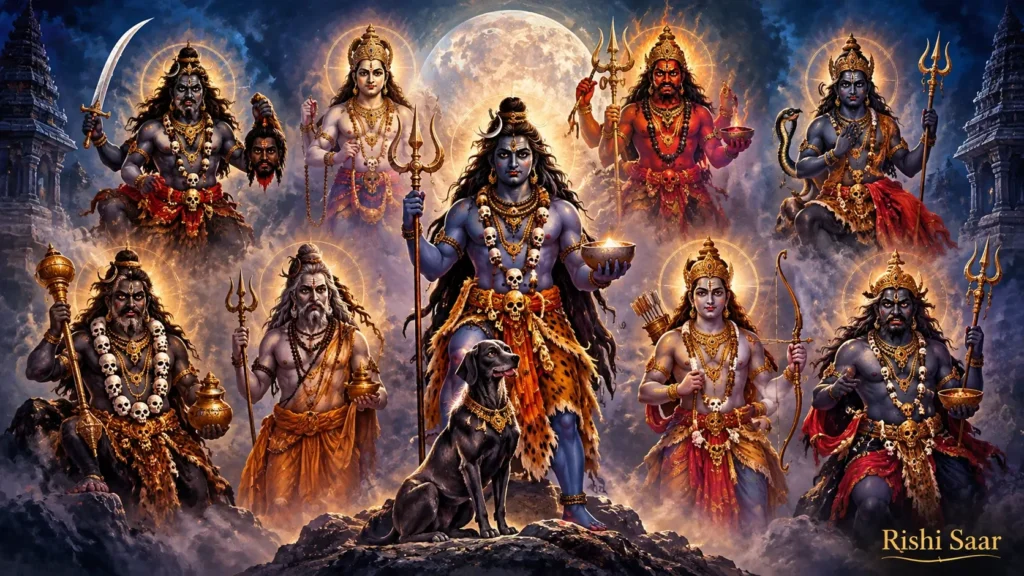
Lord Shiva manifests in numerous forms, each revealing a different aspect of the divine. Among his most formidable manifestations is Lord Bhairava, who is revered as a protector of sacred spaces and a remover of fear and ignorance.
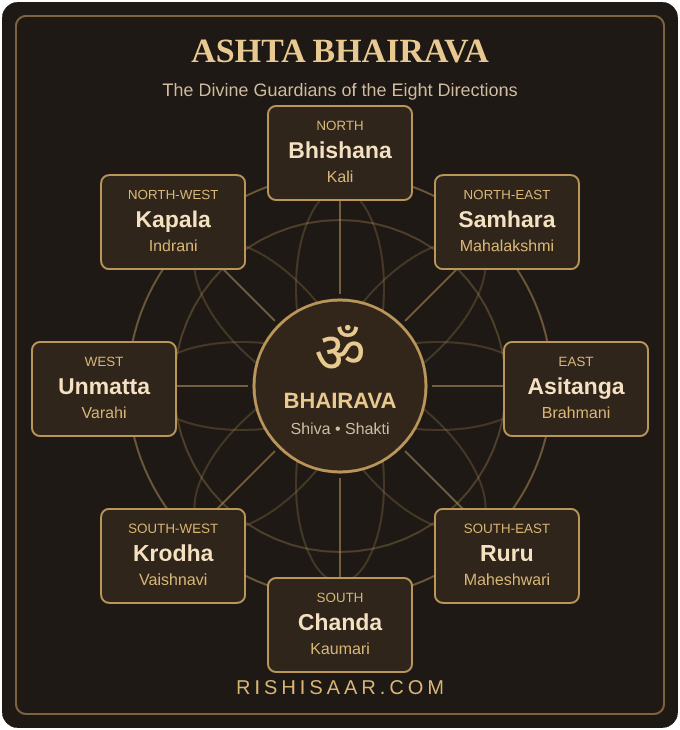
The eight principal manifestations of Lord Bhairava are collectively known as Ashta Bhairava (अष्ट भैरव). Each form is traditionally associated with a direction of the universe and a corresponding manifestation of divine feminine energy, or Shakti.
Together, they represent divine protection, spiritual transformation and the inseparable relationship between Shiva and Shakti.
What Is Ashta Bhairava?
The term Ashta Bhairava consists of two Sanskrit words:
- Ashta (अष्ट): Eight.
- Bhairava (भैरव): Terrifying, formidable or awe-inspiring.
Ashta Bhairava refers to the eight principal manifestations of Lord Bhairava recognized in Shaiva and Tantric traditions.
These manifestations are traditionally regarded as guardians of the eight directions. Certain Agamic texts further classify sixty-four Bhairavas into eight groups, each headed by one of the Ashta Bhairavas.
Lord Bhairava also has other manifestations, such as Swarna Akarshana Bhairava, who is particularly associated with prosperity, abundance and divine protection.
Origin of Lord Bhairava According to the Shiva Purana
The manifestation of Lord Bhairava is described in the Shiva Purana, Shatarudra Samhita, Chapters 8 and 9.
According to the narrative, Lord Brahma became overcome by pride and failed to recognize the supreme nature of Lord Shiva.
To correct his arrogance, Lord Shiva manifested Bhairava, who removed Brahma’s fifth head.
Bhairava subsequently undertook the Kapalika vow and wandered with Brahma’s skull, accompanied by Brahmahatya, the personification of the consequence of his action.
When Bhairava entered the sacred city of Kashi, the skull finally fell from his hand, and Brahmahatya disappeared. The place associated with this event became known as Kapalamochana.
This narrative establishes Bhairava’s special connection with Kashi and his identity as a divine guardian.
Spiritually, the story can be understood as a reminder that pride, arrogance and ignorance must be overcome on the path towards self-realization.
Ashta Bhairava Names, Directions and Associated Shaktis
The following classification is documented in research on Bhairava iconography published by the French Institute of Pondicherry.
| Bhairava | Sanskrit Name | Direction | Associated Shakti |
|---|---|---|---|
| Asitanga Bhairava | असिताङ्ग भैरव | East | Brahmani |
| Ruru Bhairava | रुरु भैरव | South-East | Maheshwari |
| Chanda Bhairava | चण्ड भैरव | South | Kaumari |
| Krodha Bhairava | क्रोध भैरव | South-West | Vaishnavi |
| Unmatta Bhairava | उन्मत्त भैरव | West | Varahi |
| Kapala Bhairava | कपाल भैरव | North-West | Indrani |
| Bhishana Bhairava | भीषण भैरव | North | Kali |
| Samhara Bhairava | संहार भैरव | North-East | Mahalakshmi or Chandika |
The descriptions, directional associations and divine companions may vary across individual scriptures and regional traditions.
The Eight Forms of Lord Bhairava and Their Spiritual Significance
1. Asitanga Bhairava (असिताङ्ग भैरव)
Asitanga Bhairava is traditionally listed first among the eight principal Bhairavas.
His name combines Asita, meaning dark, and Anga, meaning limb or body. He is associated with the eastern direction and Goddess Brahmani, the Shakti of Lord Brahma.
Despite the literal meaning of his name, certain iconographic traditions describe his group of Bhairavas with golden complexions.
Since the east is associated with sunrise and new beginnings, Asitanga Bhairava can symbolically represent the awakening of consciousness and the removal of spiritual ignorance.
Spiritual significance: Self-awareness, spiritual awakening and overcoming ignorance.
2. Ruru Bhairava (रुरु भैरव)
Ruru Bhairava governs the south-eastern direction and is associated with Goddess Maheshwari, the divine Shakti of Lord Shiva.
Interestingly, certain traditional iconographic descriptions associate his group with a veena, sacred manuscript and rosary.
These attributes distinguish Ruru Bhairava from the more familiar fierce representations of Bhairava and suggest a connection with learning, contemplation and spiritual knowledge.
His form reminds devotees that wisdom and understanding can themselves become powerful means of overcoming ignorance.
Spiritual significance: Knowledge, wisdom, discrimination and disciplined learning.
3. Chanda Bhairava (चण्ड भैरव)
Chanda Bhairava is associated with the southern direction and Goddess Kaumari, the feminine manifestation of Lord Kartikeya.
The Sanskrit word Chanda means fierce, intense or formidable.
His manifestation can be understood as divine strength directed towards the protection of Dharma.
Rather than representing uncontrolled aggression, his fierceness symbolizes the courage and determination required to confront difficulties and remain committed to righteousness.
Spiritual significance: Courage, determination and steadfastness in Dharma.
4. Krodha Bhairava (क्रोध भैरव)
Krodha Bhairava, also known as Krodhana Bhairava, is associated with the south-western direction and Goddess Vaishnavi, the Shakti of Lord Vishnu.
The Sanskrit word Krodha means anger or wrath.
His manifestation invites reflection upon the difference between destructive personal anger and divine wrath directed towards restoring cosmic balance.
From a spiritual perspective, Krodha Bhairava represents the importance of mastering emotions rather than allowing them to control one’s actions.
Spiritual significance: Self-discipline, emotional restraint and overcoming destructive anger.
5. Unmatta Bhairava (उन्मत्त भैरव)
Unmatta Bhairava is associated with the western direction and Goddess Varahi.
The Sanskrit word Unmatta refers to a state of intoxication, frenzy or extraordinary ecstasy.
Within a spiritual interpretation, this manifestation may represent freedom from conventional worldly attachments and identification with the ego.
His associated Shakti, Goddess Varahi, is a prominent deity in the Matrika and Shakta Tantric traditions.
You can explore her origin, iconography and religious significance in our detailed article on Varahi Amman.
Spiritual significance: Transcending the ego and overcoming excessive material attachment.
6. Kapala Bhairava (कपाल भैरव)
Kapala Bhairava, also known as Kapali Bhairava, governs the north-western direction and is associated with Goddess Indrani.
The Sanskrit word Kapala means skull.
The skull is an important symbol in Shaiva traditions, representing the impermanence of physical existence. It also recalls the Puranic narrative in which Lord Bhairava carries Brahma’s skull during his Kapalika vow.
Kapala Bhairava reminds devotees that physical appearance, wealth and worldly status are temporary.
Spiritual significance: Humility, detachment and awareness of life’s impermanence.
7. Bhishana Bhairava (भीषण भैरव)
Bhishana Bhairava is associated with the northern direction and Goddess Kali in the classification presented above.
The Sanskrit word Bhishana means terrifying or formidable.
Although his appearance is fearsome, Bhairava is revered in devotional traditions as a protector against fear.
This apparent contradiction carries a deeper spiritual message: fearlessness does not necessarily arise from avoiding everything frightening, but from developing the inner strength to confront uncertainty.
Spiritual significance: Fearlessness, inner strength and overcoming limitations.
8. Samhara Bhairava (संहार भैरव)
Samhara Bhairava is associated with the north-eastern direction and Goddess Mahalakshmi or Chandika, depending upon the tradition.
The Sanskrit word Samhara means dissolution or destruction.
In Hindu cosmology, dissolution is an essential part of the continuous cycle of creation, preservation and transformation.
At an individual level, Samhara Bhairava can symbolize the dissolution of ignorance, harmful attachments and ego, creating the possibility of spiritual renewal.
Spiritual significance: Transformation, detachment and spiritual liberation.
The individual spiritual meanings described above are interpretations of the names and symbolism of the Bhairavas rather than fixed benefits explicitly assigned to each form by the Puranas.
Ashta Bhairava in the Skanda Purana
One of the clearest Puranic references to the eight Bhairavas appears in the Skanda Purana, Kashi Khanda, Chapter 72, Verses 92–93.
Sanskrit Shloka:
तथैव भैरवाश्चाष्टौ दिक्ष्वष्टासु प्रतिष्ठिताः ।
रक्षंति सततं काशीं निर्वाणश्रीनिकेतनम् ॥ ९२ ॥
Transliteration:
Tathaiva Bhairavashchashtau Dikshvashtasu Pratishthitah,
Rakshanti Satatam Kashim Nirvanashriniketanam.
Meaning:
The eight Bhairavas, established in the eight directions, continually protect Kashi, the sacred abode of liberation.
The following verse identifies the eight Bhairavas as Ruru, Chanda, Asitanga, Kapali, Krodhana, Unmatta, Samhara and Bhishana.
Although their sequence differs from the commonly documented iconographic classification, their principal identities correspond.
This passage establishes their collective role as guardians of Kashi, where visiting the eight Bhairava shrines remains a religious pilgrimage tradition known as Ashta Bhairava Yatra.
Connection Between Ashta Bhairava and Ashta Matrika
The eight Bhairavas are closely associated with the Ashta Matrikas, or eight divine mother goddesses.
The Matrikas represent different manifestations of Shakti and occupy an important position in Shakta and Tantric traditions.
Their association with Bhairava reflects the philosophical relationship between Shiva and Shakti. In many Shaiva and Shakta traditions, Shiva represents consciousness, while Shakti represents its dynamic power.
Together, they embody the inseparable nature of divine consciousness and energy.
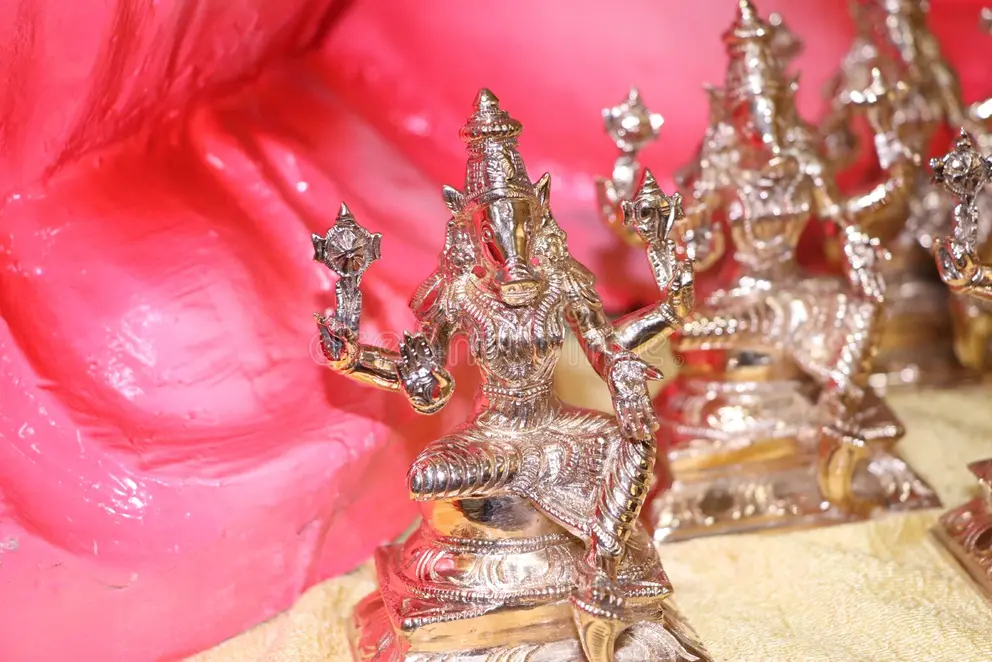
The wider Matrika tradition also includes distinctive goddesses such as the elephant-headed Vinayaki Devi, who is associated with Lord Ganesha and the sixty-four Yoginis, although she is not ordinarily included among the eight Shaktis paired with the Ashta Bhairavas.
Connection Between Ashta Bhairava and 64 Bhairavas
Certain Agamic and Tantric traditions recognize sixty-four manifestations of Lord Bhairava, collectively known as Chatushashti Bhairava (चतुःषष्टि भैरव).
These sixty-four manifestations are divided into eight groups of eight Bhairavas, with each group headed by one of the principal Ashta Bhairavas.
This classification is documented in the Sri Tattvanidhi and discussed in scholarly studies of Hindu iconography.
The sixty-four Bhairavas are also associated with the sixty-four Yoginis in certain Tantric traditions.
This interconnected classification demonstrates the importance of Bhairava worship within the broader traditions of Shiva and Shakti.
Scriptural References and Research Sources
- Shiva Purana – Shatarudra Samhita, Chapter 8 – Manifestation of Lord Bhairava.
- Shiva Purana – Shatarudra Samhita, Chapter 9 – Bhairava’s journey to Kashi.
- Skanda Purana – Kashi Khanda, Chapter 72, Verses 92–93 – The eight Bhairavas as guardians of Kashi.
- French Institute of Pondicherry – Bhairava Iconography – Names, directions, associated Shaktis and Tantric textual references.
- The Development of Hindu Iconography – J. N. Banerjea – Classification of the sixty-four Bhairavas.
- The Iconography of Lord Bhairava in Literary Sources – Traditional iconographic descriptions.
Conclusion
Ashta Bhairava represents the eightfold manifestation of Lord Bhairava, traditionally associated with the protection of the eight directions.
Their connection with the Matrikas, the sixty-four Yoginis and the sacred city of Kashi reveals their importance within Sanatan Dharma.
Beyond their formidable appearances, these manifestations encourage reflection upon courage, wisdom, humility, detachment and spiritual transformation.
Understanding their significance through authentic scriptural references allows us to appreciate the deeper religious and philosophical meaning of Bhairava worship.
Har Har Mahadev! Jai Shri Kaal Bhairav!
Frequently Asked Questions
Who is the most powerful among the eight Bhairavas?
There is no universally accepted scriptural ranking of the eight Bhairavas according to their power. All eight are manifestations of the same divine reality.
Is Kala Bhairava the same as Ashta Bhairava?
Kala Bhairava is a prominent manifestation of Lord Shiva associated with time and divine guardianship. Ashta Bhairava refers specifically to the collective group of eight principal Bhairavas.
Is Swarna Akarshana Bhairava one of the eight Bhairavas?
No. Swarna Akarshana Bhairava is a separate manifestation associated with prosperity and abundance and is not ordinarily included in the principal group of eight.
Can Ashta Bhairava be worshipped at home?
Devotees may offer simple prayers and devotional salutations at home. Specialized Tantric practices may require initiation and guidance from a qualified spiritual teacher.
Is Ashta Bhairava the same as Ashtamurti Shiva?
No. Ashta Bhairava refers to the eight principal forms of Bhairava, whereas Ashtamurti Shiva refers to a different eightfold classification of Lord Shiva.